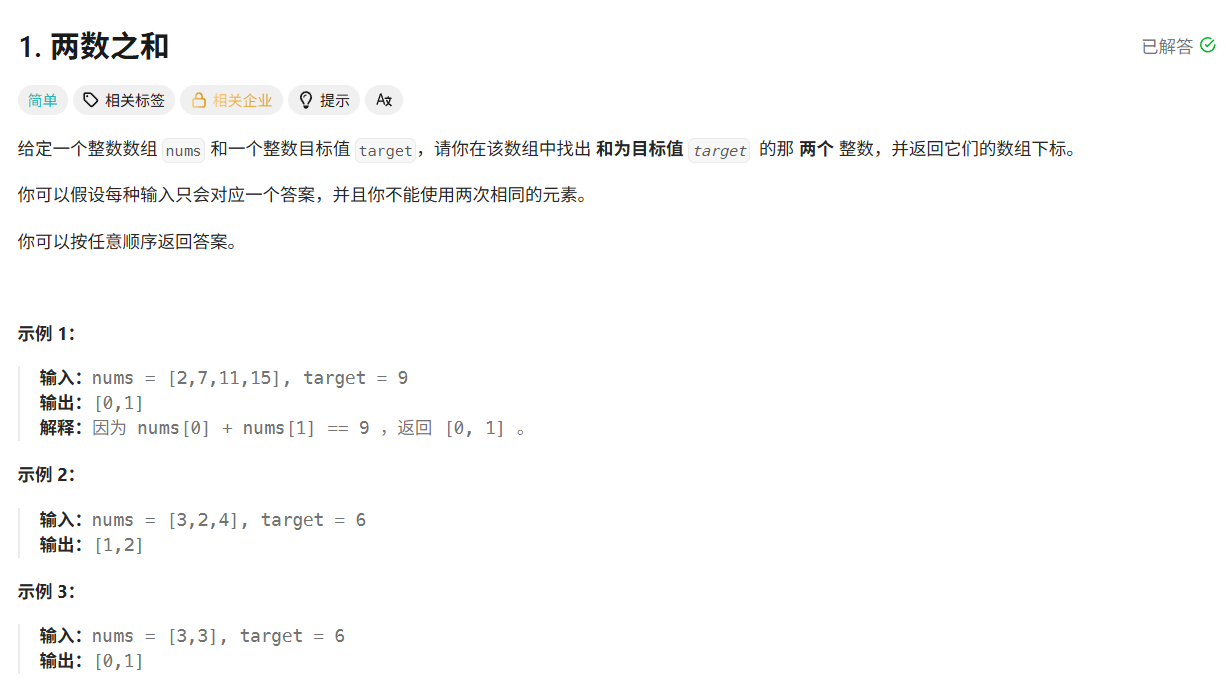
哈希表 两数之和
解答一:使用暴力算法
1
2
3
4
5
6
7
8
9
10
11
12
13
public int [] TwoSum (int [] nums, int target int [] arrs = new int [2 ]; for (int i = 0 ; i < nums.Length; i++) { for (int j = i + 1 ; j < nums.Length; j++) { if (nums[i] + nums[j] == target) { arrs[0 ] = i; arrs[1 ] = j; return arrs; } } } return arrs; }
解答二:使用字典
1
2
3
4
5
6
7
8
9
10
11
12
13
14
15
16
public class Solution { public int [] TwoSum (int [] nums, int target { Dictionary<int ,int > Dic = new Dictionary<int ,int >(); for (int i = 0 ;i< nums.Length;i++) { int num = target - nums[i]; if (Dic.ContainsKey(num)) { return new int [] {Dic[num], i}; } Dic[nums[i]] = i; } return new int [] {}; } }
字母异位词分组 字母异位词分组
使用字典进行求解,首先通过循环遍历每个字符串,将其转换为字符数组并且进行排序。在排序结束后使用存入字典,能够相互排列的存入一个列表中,最后返回
1
2
3
4
5
6
7
8
9
10
11
12
13
14
15
public class Solution { public IList<IList<string >> GroupAnagrams(string [] strs) { Dictionary<string ,List<string >> Dic = new Dictionary<string ,List<string >>(); foreach (var str in strs){ char [] c = str.ToCharArray(); Array.Sort(c); string key = new string (c); if (!Dic.ContainsKey(key)) Dic[key] = new List<string >(); Dic[key].Add(str); } return new List<IList<string >>(Dic.Values); } }
最长连续序列 使用HashSet进行解决,将数组的值全部存入HashSet中,循环遍历每个元素,对于每一个元素i来说,i - 1是否存在在集合中,如果不存在则说明i 是一个新的连续序列的起点,从i开始遍历i+1,i+2等等,最后将每个新起点的长度进行比较,找到最大的序列;
1
2
3
4
5
6
7
8
9
10
11
12
13
14
15
16
17
18
19
public class Solution { public int LongestConsecutive (int [] nums HashSet<int > ans = new HashSet<int >(nums); int max = 0 ; foreach (var i in ans){ if (!ans.Contains(i - 1 )){ int currentNum = i; int currentLen = 1 ; while (ans.Contains(currentNum + 1 )){ currentLen++; currentNum = currentNum + 1 ; } max = Math.Max(max,currentLen); } } return max; } }
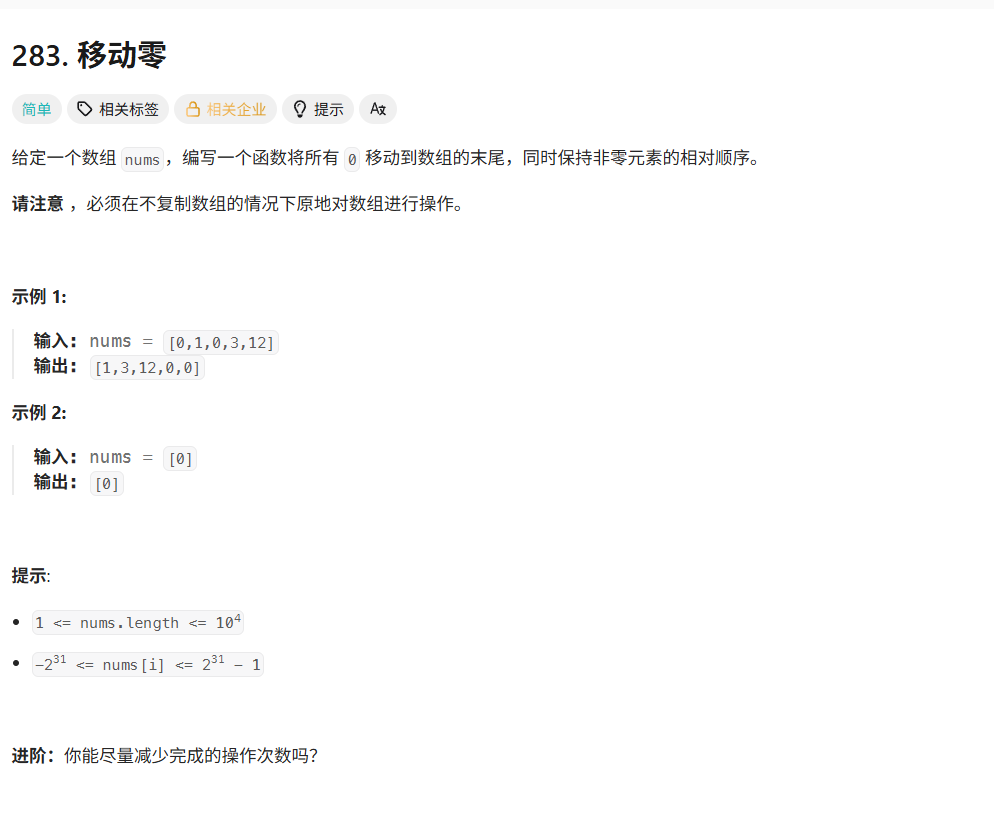
双指针
使用快慢指针,当数组的当前元素等于0时,慢指针不动,快指针往后走,遇到非0元素后,将当前的非0元素放入慢指针出,此时慢指针+1,依此。将所有的非0元素往前移了,后面的元素全部用0补齐;
1
2
3
4
5
6
7
8
9
10
11
12
13
14
public class Solution { public void MoveZeroes (int [] nums int L = 0 ; for (int i = 0 ; i < num.Length;i++){ if (nums[i]!=0 ){ num[L] = num[i]; L++; } } for (int i = L;i<nums.Length;i++) nums[i]= 0 ; } }
1
2
3
4
5
6
7
8
9
10
11
12
13
14
15
16
17
18
19
20
21
22
23
24
25
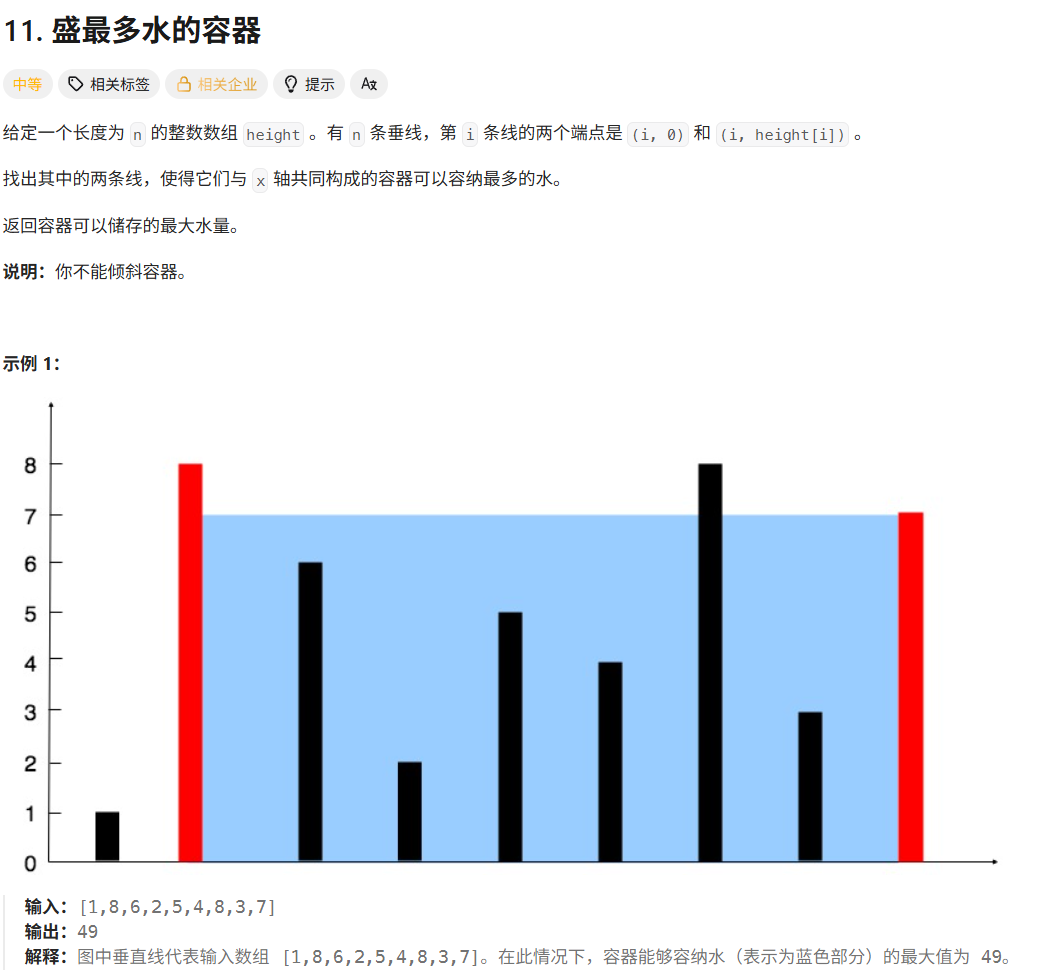
public class Solution { public int MaxArea1 (int [] height int max = 0 ; for (int i = 0 ;i < height.Length;i++){ for (int j = i + 1 ;j<height.Length;j++){ int ans = (j - i) * (Math.Min(height[j],height[i])); max = Math.Max(max,ans); } } return max; } public int MaxArea (int [] height int L = 0 ; int R = height.Length - 1 ; int maxArea = 0 ; while (L < R){ maxArea = Math.Max(maxArea,(R - L) * (Math.Min(height[R],height[L]))); if (height[L] < height[R]) L++; else R--; } return maxArea; } }
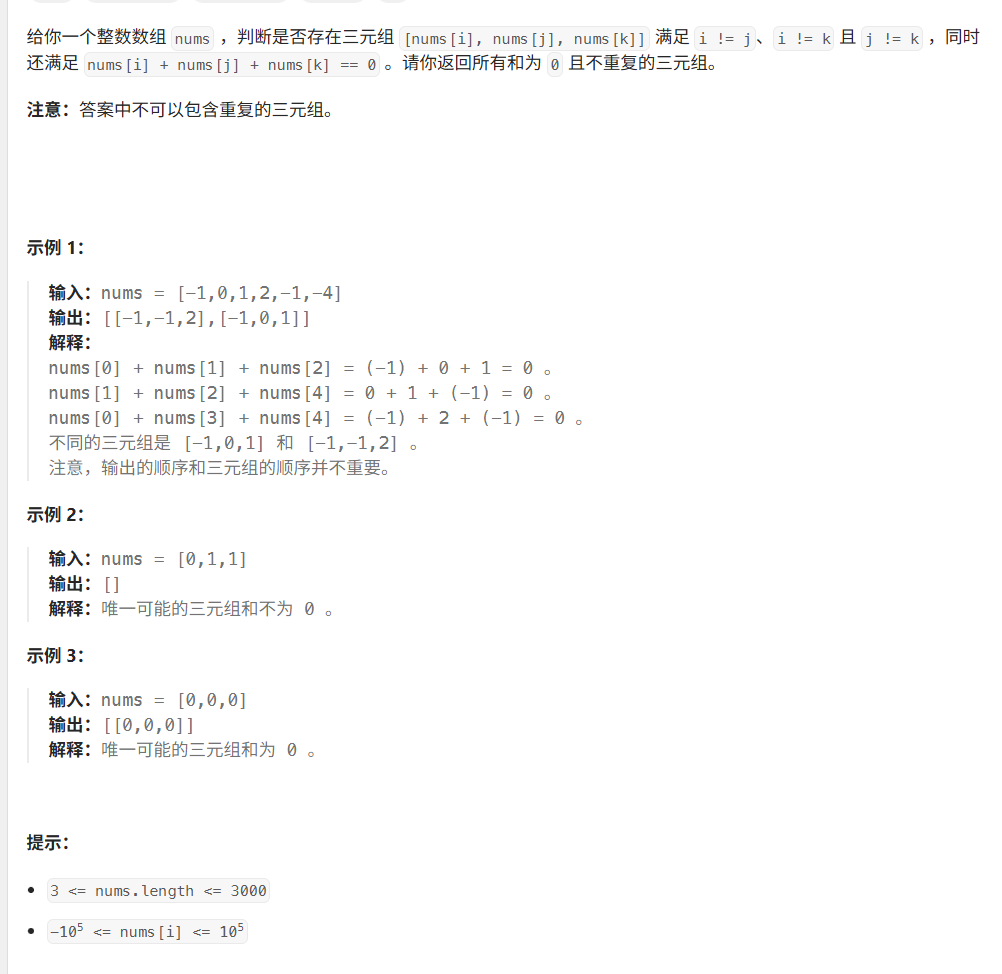
用双指针+去重解决这个问题
首先这个题目没有要我们输出位置,因此我们可以改变原数组的位置,进行sort排序一下,这样数组就是从小到大依次排列。
然后我们从头开始进行遍历(int i= 0,这里要注意i也有可能是重复的,因此有个去重代码)
然后设置俩个指针,一个从i+1,另外一个从数组尾部,进入第二层循环,找三个位置相加为0的数字,如果找到了,就记录进结果中
1
2
3
4
5
6
for (int i = 0 ;i < nums.Length - 2 ;i++){ int j = i + 1 ; int t = nums.Lenght - 1 ; if (nums[i] == nums[i+1 ]) continue ; }
这里要注意了,记录进结果之后,我们要对两个指针进行移位,去重也就是在这里发生的。
假设i在num[0],j在nums[1],t在最后一个2,现在三个相加为0,然后两个指针开始移动,发现 j = j + 1,j + 1 = j + 2 ,j + 2 != j +3,那么 j 就会移动到 j+2 的位
置(答案中不可以包含重复的三元组。),同理t会移动到最前面那个2,然后再进行一个 j++,t–,达成去重的目的。后面就是如果sum小于0的话,j 就向前移位,大于0的话,t 就向后移位。
1
2
3
4
5
6
7
8
9
10
11
12
13
14
15
16
17
18
19
20
21
22
23
24
25
26
27
28
29
30
31
public class Solution { public IList<IList<int >> ThreeSum(int [] nums) { var ans = new List<IList<int >>(); Array.Sort(nums); for (int i = 0 ;i < nums.Length - 2 ;i++){ int j = i + 1 ; int t = nums.Length - 1 ; if (nums[i] == nums[i + 1 ]) continue ; while (j < t){ int sum = nums[i] + nums[j] + nums[t]; if (sum == 0 ){ ans.Add(new List<int >{num[i],nums[j],nums[t]}); while (j < t && nums[j] == nums[j + 1 ])j++: while (j < t && nums[t] == nums[t - 1 ])t--; j++; t--; } else if (sum < 0 ) j++; else t--; } } return ans; } }
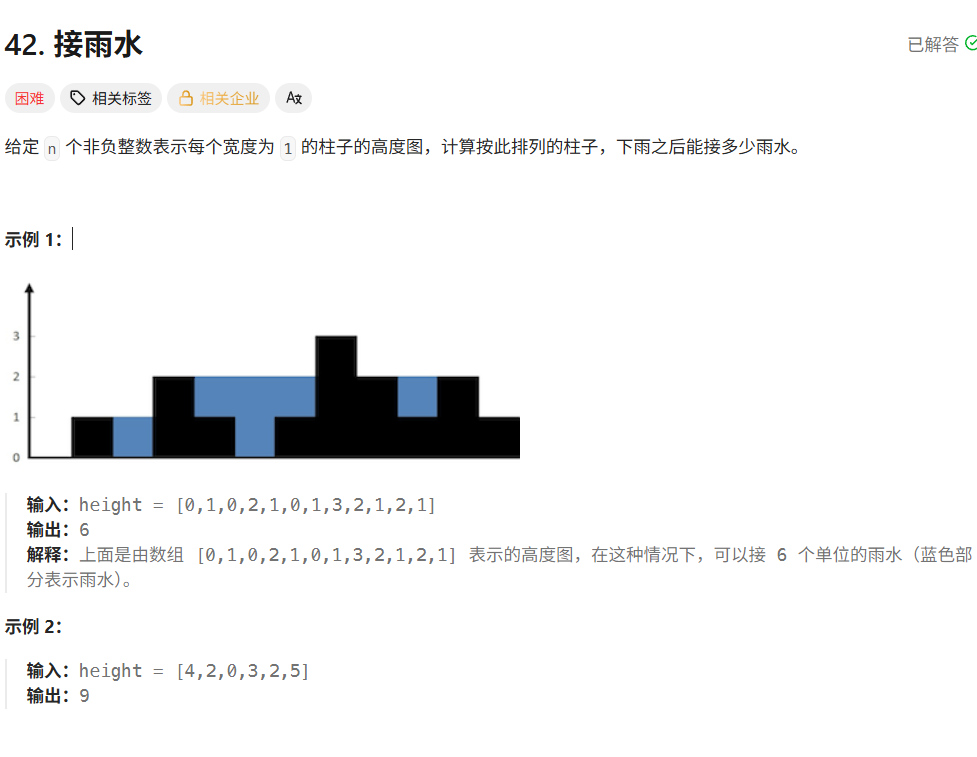
算法思路:双指针法:
双指针法 :使用两个指针,left从数组开头开始,right从数组末尾开始。
记录左右最大高度 :维护两个变量 pre_max(从左往右遍历时的当前最大高度)和 las_max(从右往左遍历时的当前最大高度)。
计算雨水 :每一步比较 pre_max和 las_max:
如果 pre_max> las_max,说明右边的墙足够高,可以接住左边的雨水,计算 left位置的积水量(pre_max - height[left]),然后 left右移。
否则,说明左边的墙足够高,可以接住右边的雨水,计算 right位置的积水量(las_max - height[right]),然后 right左移。
返回结果 :最终累加的 ans就是能接住的雨水总量。
1
2
3
4
5
6
7
8
9
10
11
12
13
14
15
16
17
18
19
20
21
22
23
public class Solution { public int Trap (int [] height if (height == null || height.Length <= 2 ) return 0 ; int ans = 0 ; int left = 0 ; int right = height.Length - 1 ; int pre_max = 0 ; int las_max = 0 ; while (left <= right){ if (height[left] < height[right]){ pre_max = Math.Max(pre_max,height[left]); ans += pre_max - height[left]; left++; } else { las_max = Math.Max(las_max,height[right]); ans += las_max - height[right]; right--; } } return ans; } }
全0子数组的数目
进行分区处理。定义一个变量记录每个区间段0的数目,遍历数组,如果遇到0,变量++。在遇到非0数字时进行计算。但是如果非0区间在最后一段可能无法处理,因为计算是遇到非0数时,所以最后需要单独处理
1
2
3
4
5
6
7
8
9
10
11
12
13
14
15
public class Solution { public long ZeroFilledSubarray (int [] nums int sum = 0 ; int max = 0 ; for (int i= 0 ;i < nums.Length;i++){ if (nums[i] == 0 ){ sum++; } else { max += (sum * (sum + 1 ) / 2 );; } } return (max + (sum + 1 ) * sum / 2 ); } }
滑动窗口 滑动窗口是一种用于处理数组/字符串 子区间问题的优化技术。它通过维护一个窗口(通常是连续的子数组/子字符串),在数据上滑动,从而避免重复计算,将时间复杂度从暴力解的 O(n²) 或更高降到 O(n)。
适用题型 :
问题涉及连续子数组 或子字符串
通常求:最长/最短满足某条件的子数组长度满足条件的子数组个数子数组的最大/最小值等
常见关键词:“连续”、“子串”、“无重复字符”、“和大于/等于某值”
滑动窗口基本类型
3.1 固定长度窗口
窗口大小固定为 k,每次向右移动一步,用于解决定长子数组的问题。
示例问题 :大小为 k 的子数组的最大和。
步骤 :
计算第一个窗口的和。
从第二个窗口开始,每次加新元素,减旧元素,更新结果。
3.2 可变长度窗口
窗口大小不固定,根据条件动态扩展或收缩。
常见两种模式 :
求最小长度 :不断扩大右边界直到满足条件,然后收缩左边界直到不满足条件,记录最小长度。求最大长度 :不断扩大右边界,当不满足条件时收缩左边界直到满足条件,记录最大长度。
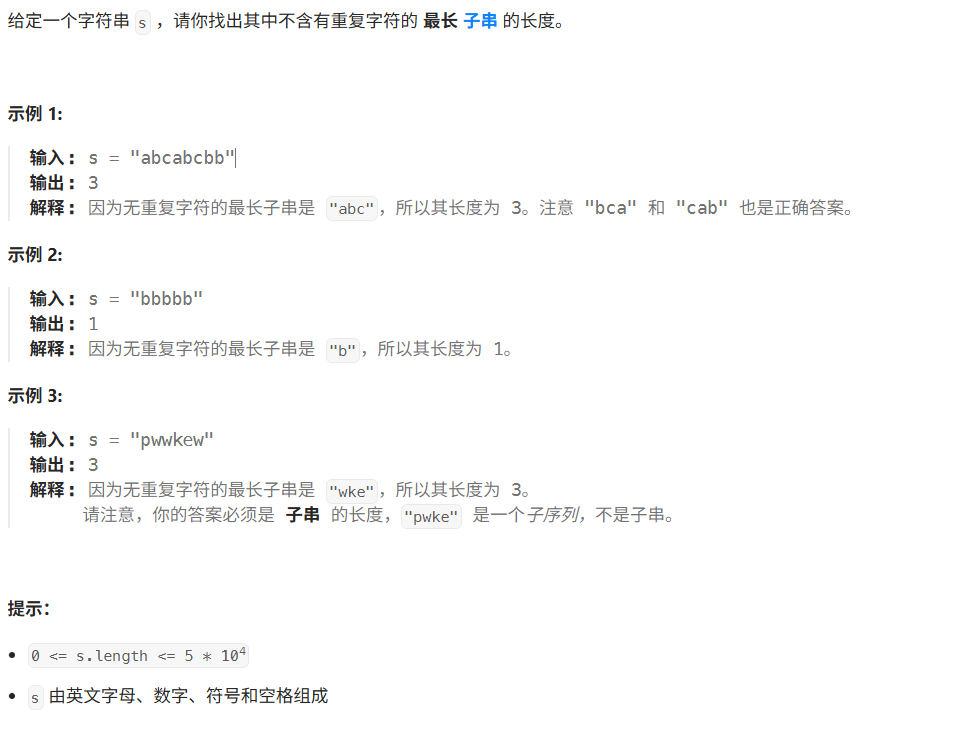
如本题长度是动态的,我们需要进行动态扩展窗口。
首先创建一个HashSet来记录字符出现的位置,如果首次出现,则存入HashSet,在此出现,则证明出现了重复字符,此时一直循环删除HashSet元素,直至没有重复元素重写
首先从字符串下标为0开始,遍历存储。
使用maxLen记录最长子串
1
2
3
4
5
6
7
8
9
10
11
12
13
14
15
16
public class Solution { public int LengthOfLongestSubstring (string s int L = 0 ; int maxLen = 0 ; HashSet<char > set = new HashSet<char >(); for (int R = 0 ;R < s.Length;R++){ while (set .Contains(s[R])){ set .Remove(s[L]); L++; } set .Add(s[R]); maxLen = Math.Max(R - L + 1 ,maxLen); } return maxLen; } }
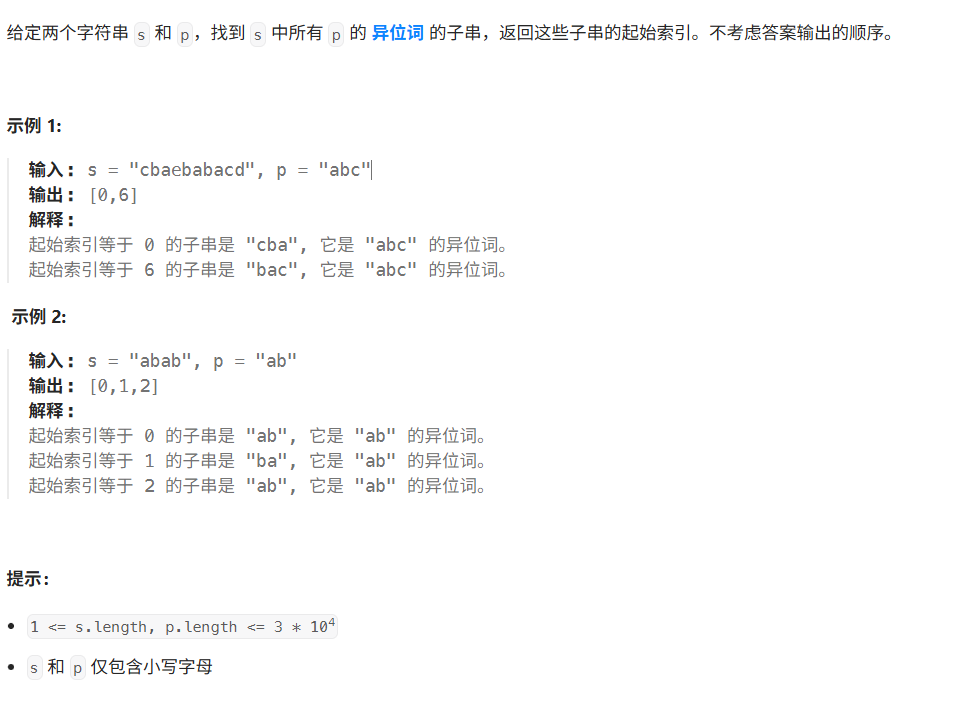
思路算法与最小覆盖子串(题号:76)很相似;但是有所不同,这个题目是找到起始索引,代表着子串要完全满足p字符串的异位词,在子串中不能包含其他无关紧要的字符
完整的解题思路:
初始化 :统计p的字符计数到need字典
构建初始窗口 :先处理前p.Length个字符右指针从0移动到p.Length-1统计这些字符到window字典
滑动窗口检查 :固定区间范围,每当区间长度满足Right - Left == p.Length就进行一次判断,如果满足此区间的子串是异位词则存入列表,left则右移去进行下一个区间的判断
1 2 3 4 5 6 7 8 9 10 11 12 13 14 while (Right - Left == p.Length) { if (Vaild == need.Count) ans.Add(Left); char d = s[Left]; Left++; if (need.ContainsKey(d)) { if (windows[d] == need[d]) Vaild--; windows[d]--; } }
优化判断 :使用valid计数器当某个字符数量达到需求时,valid++当valid == need.Count时,且窗口大小固定 ⇒ 必然完全匹配
1
2
3
4
5
6
7
8
9
10
11
12
13
14
15
16
17
18
19
20
21
22
23
24
25
26
27
28
29
30
31
32
33
34
35
36
37
public class Solution { public IList<int > FindAnagrams (string s, string p List<int > ans = new List<int >(); Dictionary<char ,int > need = new Dictionary<char ,int >(); foreach (var c in p){ need[c] = need.ContainsKey(c)?need[c] + 1 :1 ; } Dictionary<char ,int > windows = new Dictionary<char ,int >(); int Left = 0 ; int Right = 0 ; int Vaild = 0 ; while (Right < s.Length){ char c = s[Right]; Right++; if (need.ContainsKey(c)){ windows[c] = windows.ContainsKey(c)?windows[c] + 1 : 1 ; if (need[c] == windows[c]) Vaild++; } while (Right - Left == p.Length) { if (Vaild == need.Count) ans.Add(Left); char d = s[Left]; Left++; if (need.ContainsKey(d)) { if (windows[d] == need[d]) Vaild--; windows[d]--; } } } return ans; } }
子串
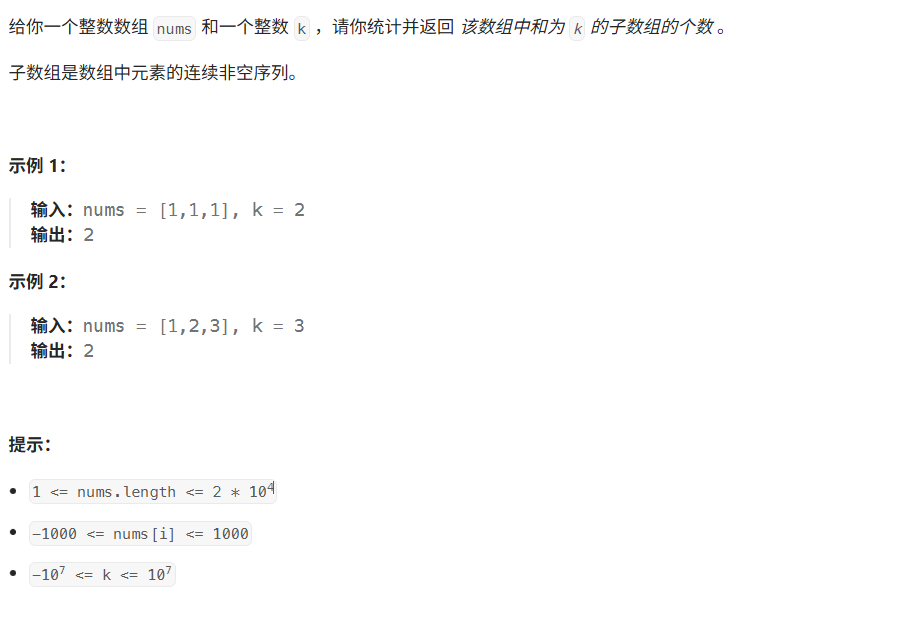
此题的关键就是子数组 nums[i...j]的和等于 k,即:
1 sum[i...j] = prefixSum[j] - prefixSum[i-1 ] = k
转换得:
1 prefixSum[i-1 ] = prefixSum[j] - k
只要找到了这个即可解,相当于前缀和 - 前面的某个前缀和 = 这段区间的和
1 2 3 4 5 6 7 8 9 10 11 12 13 14 15 16 17 18 19 public class Solution { public int SubarraySum (int [] nums, int k int ans = 0 ; int sum = 0 ; for (int i = 0 ;i < nums.Length;i++){ sum = 0 ; for (int j = i; j < nums.Length;j++){ sum += nums[j]; if (sum == k){ ans++; continue ; } } } return ans; } }
时间复杂度 :O(n²) - 对于每个起始点 i,都遍历了所有可能的结束点 j
空间复杂度 :O(1)
使用前缀和 + 哈希表(最优解)可以优化上述操作
使用前缀和来避免重复计算
利用哈希表记录前缀和出现的次数
对于每个位置,查找 prefix_sum - k是否出现过
我们要找的是子数组 nums[i...j]的和等于 k,即:
1 sum[i...j] = prefixSum[j] - prefixSum[i-1 ] = k
转换得:
1 prefixSum[i-1 ] = prefixSum[j] - k
如:对于数组 [1, 1, 1], k = 2:
前缀和变化:0 → 1 → 2 → 3
当 prefixSum = 2 时,查找 prefixSum - k = 0,找到1次
当 prefixSum = 3 时,查找 prefixSum - k = 1,找到1次
总共找到2个子数组:[1,1] 和 [1,1](不同的位置)
1
2
3
4
5
6
7
8
9
10
11
12
13
14
15
16
17
18
19
20
21
22
public class Solution { public int SubarraySum (int [] nums, int k Dictionary<int ,int > Dic = new Dictionary<int ,int >(); Dic[0 ] = 1 ; int total = 0 ; int sum = 0 ; for (int i = 0 ;i < nums.Length;i++){ sum += nums[i]; if (Dic.ContainsKey(sum - k)) { total += Dic[sum - k]; } if (Dic.ContainsKey(sum)){ Dic[sum]++; } else { Dic[sum] = 1 ; } } return total; } }
暴力求解(但是超时)
1
2
3
4
5
6
7
8
9
10
11
12
13
14
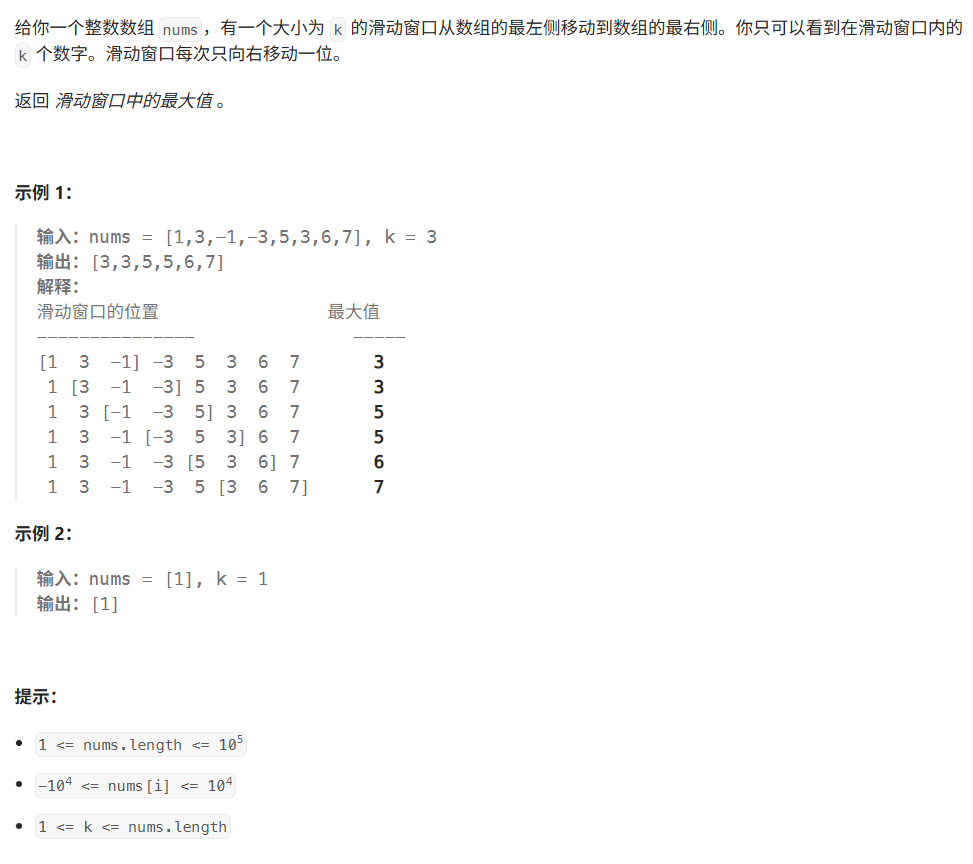
public class Solution { public int [] MaxSlidingWindow (int [] nums, int k int max = -10000 ; List<int > ans = new List<int >(); for (int i = 0 ;i < nums.Length - k;i++){ max = -10000 ; for (int j = i;j < k + i;j++){ max = Math.max(max,nums[j]); } ans.Add(max); } return ans.ToArray(); } }
单调栈求解
普通数组
前缀和求解题目:
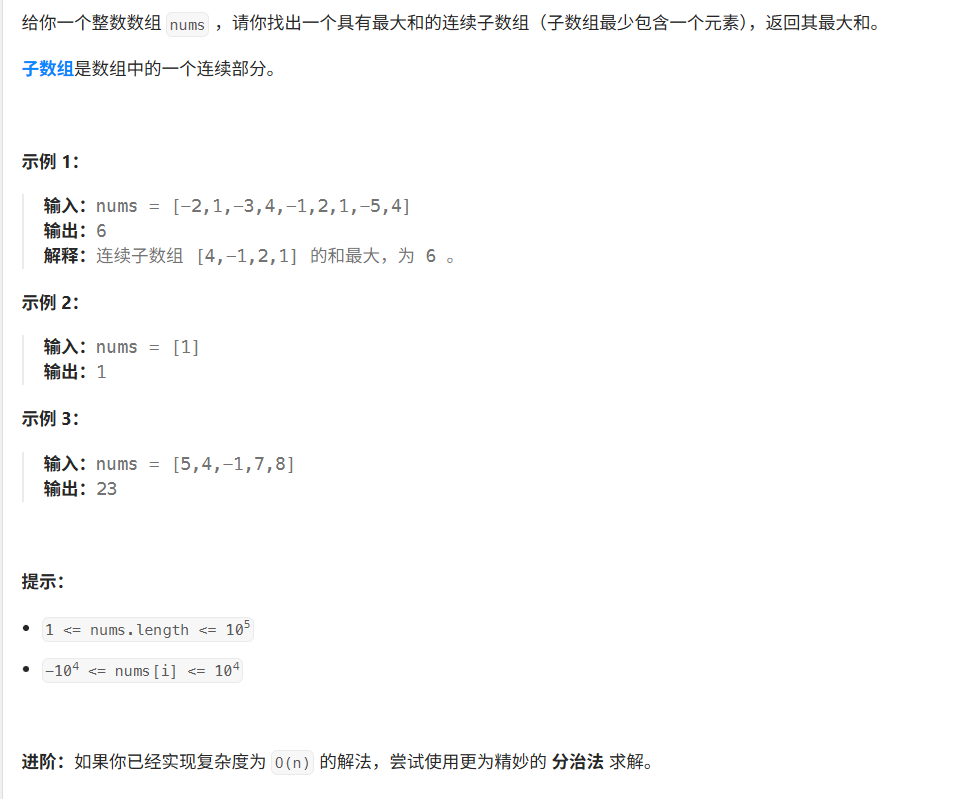
题目要求求解最大连续子数组,不要求返回数组下标,返回值即可。
采用前缀和求解,当前最大和连续子数组 = 当前前缀 - 当前已经遍历得到的最小前缀
使用Math.Max()方法得到最大的连续子数组即可
1
2
3
4
5
6
7
8
9
10
11
12
13
public class Solution { public int MaxSubArray1 (int [] nums int ans = -10000 ; int curMax = 0 ; int min = 0 ; for (int i = 0 ;i < nums.Length;i++){ curMax += nums[i]; ans = Math.Max(ans,curMax - min); min = Math.Min(min,curMax); } return ans; } }
动态规划
1
2
3
4
5
6
7
8
9
10
11
public int MaxSubArray (int [] nums if (nums.Length == 0 || nums == null ) return 0 ; int maxNum = nums[0 ]; int cur = nums[0 ]; for (int i = 1 ;i < nums.Length;i++){ cur = Math.Max(nums[i],cur + nums[i]); maxNum = Math.Max(cur,maxNum); } return maxNum; }
矩阵
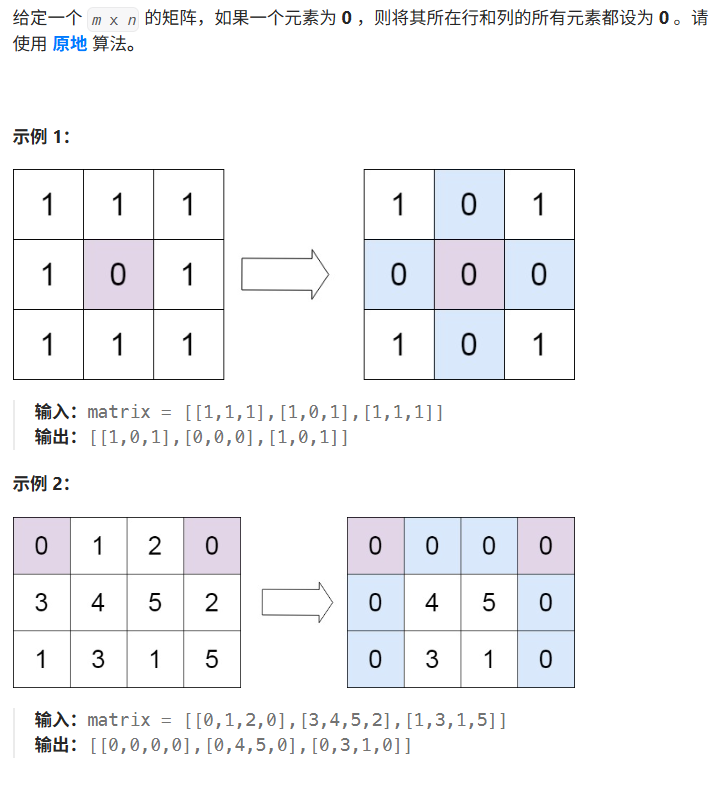
对于本题,题目要求值为0的行,列都要为0。我们直接遍历找到所有为0的数字的行,列,使用2个数组分别存储值为0的行,列。最后在此从头遍历,如果遇到行或者列为0的直接置为0,因为(行或列相同直接为0)
1
2
3
4
5
6
7
8
9
10
11
12
13
14
15
16
17
18
19
20
21
22
23
24
25
26
27
28
public class Solution { public void SetZeroes (int [][] matrix int m = matrix.Length; int n = matrix[0 ].Length; bool [] ZeroRow = new bool [m]; bool [] ZeroCol = new bool [n]; for (int i = 0 ;i < m;i++){ for (int j = 0 ;j < n;j++){ if (matrix[i][j] == 0 ) { ZeroRow[i] = true ; ZeroCol[j] = true ; } } } for (int i = 0 ;i < m;i++){ for (int j = 0 ;j < n;j++){ if (ZeroRow[i] || ZeroCal[j]) matrix[i][j] = 0 ; } } } }
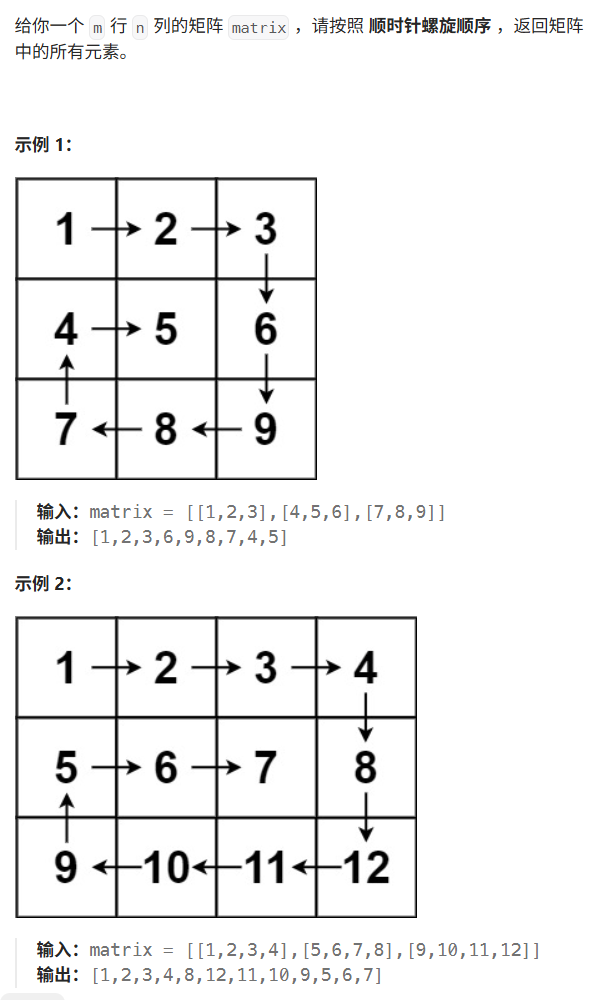
使用四个边界指针来定义当前的遍历范围,每次完成一条边的遍历后,收缩对应的边界。设置四个遍历代表从左到右,从上到下。遍历一次,就收缩一次边界,同时检测边界是否满足条件。
1
2
3
4
5
6
7
8
9
10
11
12
13
14
15
16
17
18
19
20
21
22
23
24
25
26
27
28
29
30
31
32
33
34
35
36
public class Solution { public IList<int > SpiralOrder (int [][] matrix if (matrix.Length == 0 || matrix[0 ].Length == 0 || matrix == null ){ return new List<int >(){}; } List<int > ans = new List<int >(); int m = matrix.Length; int n = matrix[0 ].Length; int up = 0 ; int down = m - 1 ; int left = 0 ; int right = n - 1 ; while (true ){ for (int i = left;i <=right;i++) ans.Add(matrix[up][i]); if (++up > down) break ; for (int i = up;i <= down;i++) ans.Add(matrix[i][right]); if (--right < left) break ; for (int i = right;i >= left;i--) ans.Add(matrix[down][i]); if (--down < up) break ; for (int i = down;i >= up;i--) ans.Add(matrix[i][left]); if (++left > right) break ; } return ans; } }
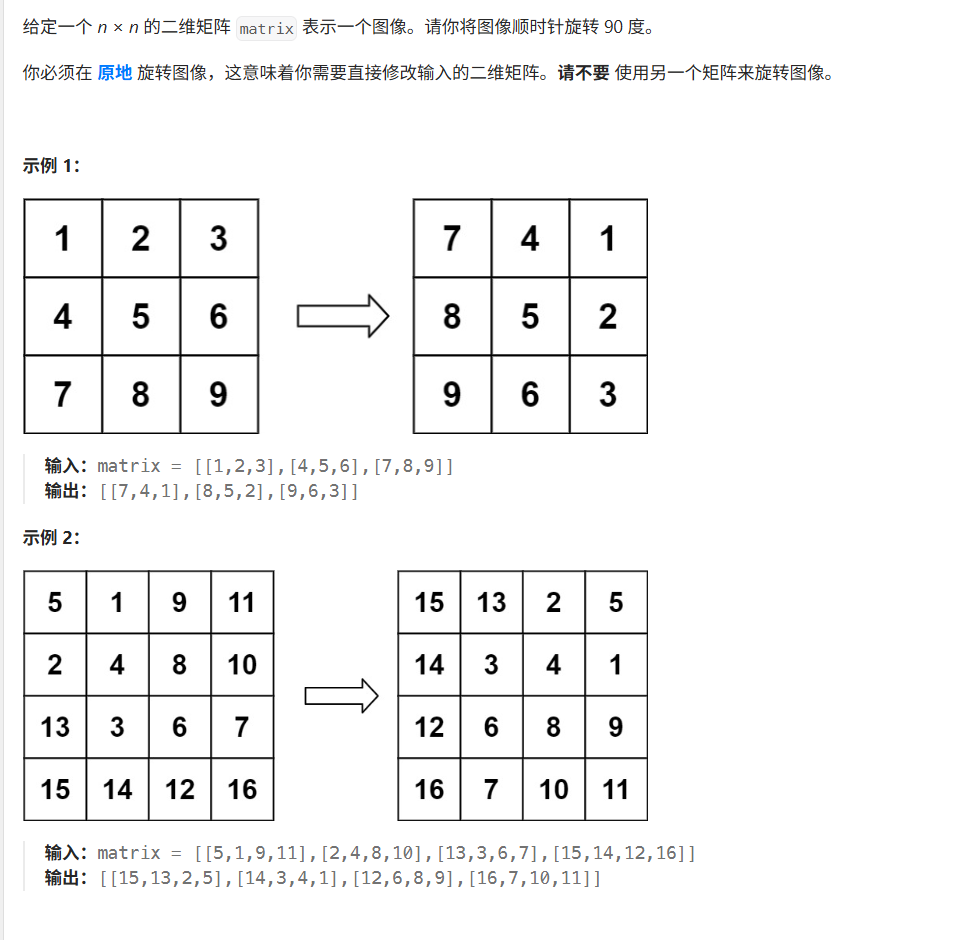
先转置后关于中间轴进行交换(n / 2)
矩阵原地转置 :把矩阵的「行」变成「列」,为后续旋转铺垫 —— 转置后,元素的位置会初步调整到旋转 90° 所需的大致区域。
遍历方阵的「上三角部分」(j 从 i+1 开始),因为方阵转置的本质是「交换 (i,j) 和 (j,i) 成对元素」;
只遍历上三角是为了避免重复交换(比如 (0,1) 和 (1,0) 只换 1 次,若遍历全部元素会换 2 次恢复原状);
主对角线元素(i=j)位置不变,无需处理。
每行水平镜像翻转 :在转置的基础上,通过左右翻转,让元素最终落到顺时针旋转 90° 的目标位置。
遍历每一行,仅处理该行的「前半列」(j < n/2),因为每一对左右对称的元素只需交换 1 次;
对称位置公式:第 j 列的元素 ↔ 第 (n-1-j) 列的元素(比如 n=3 时,j=0 对应 j=2,j=1 是中间列无需交换);
列只遍历一半,避免同一对元素重复交换,提升效率。
1
2
3
4
5
6
7
8
9
10
11
12
13
14
15
16
17
18
19
20
21
public class Solution { public void Rotate (int [][] matrix int n = matrix.Length; for (int i = 0 ;i < n;i++){ for (int j = i + 1 ; j < n;j++){ int temp = matrix[i][j]; matrix[i][j] = matrix[j][i]; matrix[j][i] = temp; } } for (int i = 0 ;i < n;i++){ for (int j = 0 ;j < n / 2 ;j++){ int temp = matrix[i][j]; matrix[i][j] = matrix[i][n - 1 - j]; matrix[i][n - 1 - j] = temp; } } } }
链表
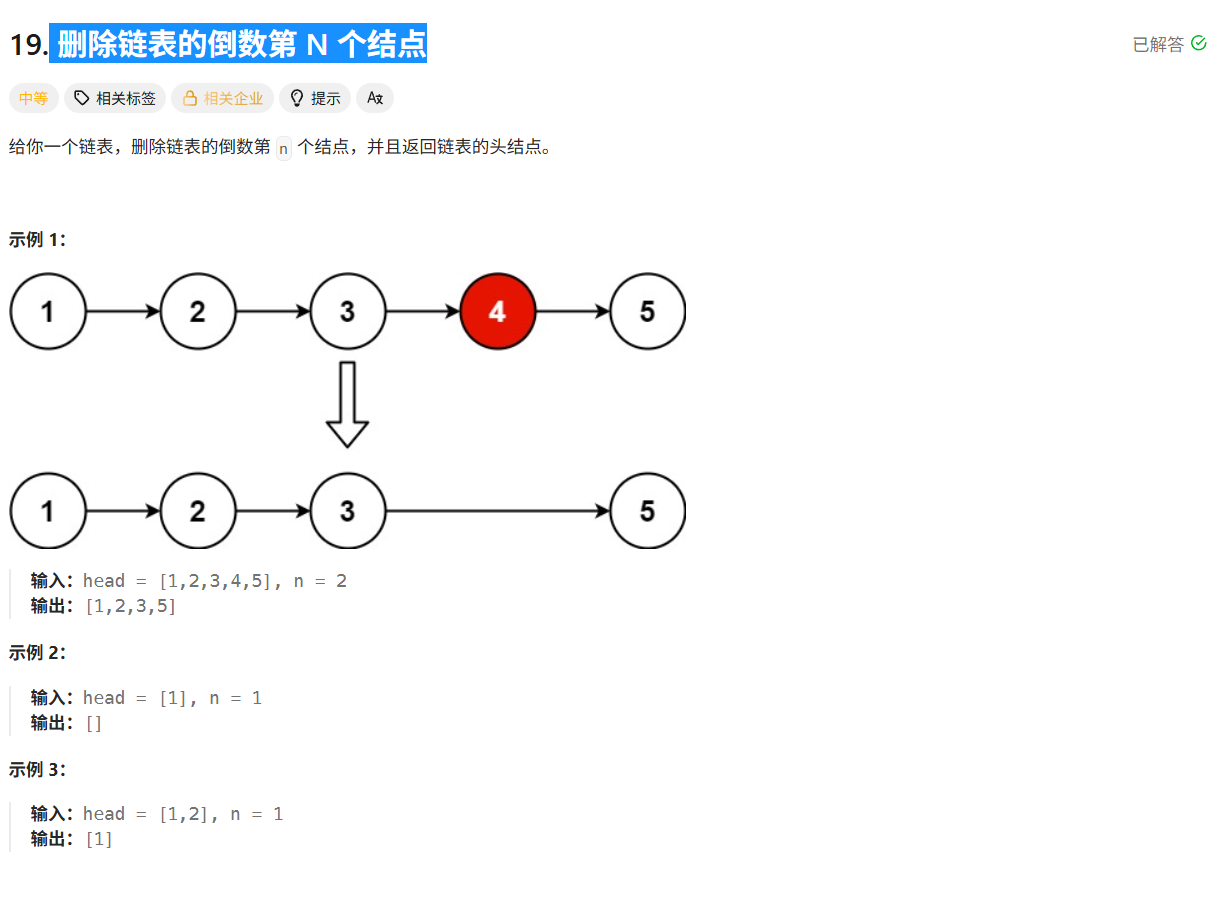
先通过遍历链表计算出链表的总长度 N,然后确定需要删除的倒数第 n 个节点对应的正数位置 m(即 N-n),若 m 为 0 则说明要删除头节点,直接返回头节点的下一个节点即可;否则重新遍历链表找到要删除节点的前一个节点,通过该节点的 next 指针跳过要删除的节点,并将被删除节点的 next 指针置空以断开引用,最终返回原头节点。
1 2 3 4 5 6 7 8 9 10 11 12 13 14 15 16 17 18 19 20 21 22 23 24 25 26 27 28 29 30 31 32 33 34 35 36 37 38 39 40 41 public class Solution { public ListNode RemoveNthFromEnd (ListNode head, int n ) if (head == null ) return null ; int N = 0 ; ListNode cur = head; while (cur != null ){ cur = cur.next; N++; } int m = N - n; if (m == 0 ){ ListNode newHead = head.next; head.next = null ; return newHead; } cur = head; while (m > 1 ){ cur = cur.next; m--; } ListNode ToDelete = cur.next; if (ToDelete != null ){ cur.next = ToDelete.next; ToDelete.next = null ; } return head; } }
1
2
3
4
5
6
7
8
9
10
11
12
13
14
15
16
17
18
19
20
21
22
23
24
25
26
27
28
29
30
31
32
33
34
35
36
37
38
39
40
41
42
43
44
45
46
47
48
49
50
51
52
53
public class Solution { public ListNode MergeTwoLists1 (ListNode list1, ListNode list2 ) ListNode head = new ListNode(-1 ); ListNode cur = head; while (list1!=null && list2!=null ){ if (list1.val < list2.val) { cur.next= new ListNode(list1.val); cur = cur.next; list1 = list1.next; } else if (list1.val > list2.val){ cur.next = new ListNode(list2.val); cur = cur.next; list2 = list2.next; } else { cur.next = new ListNode(list1.val,null ); cur.next.next= new ListNode(list2.val,null ); cur = cur.next.next; list1 = list1.next; list2 = list2.next; } } while (list1!=null ){ cur.next = new ListNode(list1.val); cur = cur.next; list1 = list1.next; } while (list2!=null ){ cur.next = new ListNode(list2.val); cur = cur.next; list2 = list2.next; } return head.next; } public ListNode MergeTwoLists (ListNode list1, ListNode list2 ) if (list1 == null ) return list2; if (list2 == null ) return list1; if (list1.val < list2.val){ list1.next = MergeTwoLists(list1.next,list2); return list1; } else { list2.next = MergeTwoLists(list1,list2.next); return list2; } } }
1
2
3
4
5
6
7
8
9
10
11
12
13
14
15
16
17
18
19
20
21
22
23
24
25
26
27
28
29
30
31
32
33
34
35
36
37
38
39
40
41
42
43
44
45
46
47
public class Solution { public ListNode RemoveNthFromEnd1 (ListNode head, int n ) if (head == null ) return null ; int N = 0 ; ListNode cur = head; while (cur != null ){ cur = cur.next; N++; } int m = N - n; if (m == 0 ){ ListNode newHead = head.next; head.next = null ; return newHead; } cur = head; while (m > 1 ){ cur = cur.next; m--; } ListNode ToDelete = cur.next; if (ToDelete != null ){ cur.next = ToDelete.next; ToDelete.next = null ; } return head; } public ListNode RemoveNthFromEnd (ListNode head, int n ) if (head == null ) return null ; ListNode dummyNode = new ListNode(0 ); dummyNode.next = head; ListNode fast = dummyNode; ListNode slow = dummyNode; while (n-- != 0 && fast.next != null ){ fast = fast.next; } while (fast.next != null ){ fast = fast.next; slow = slow.next; } slow.next = slow.next.next; return dummyNode.next; } }
1
2
3
4
5
6
7
8
9
10
11
12
13
14
15
16
17
18
19
20
21
22
23
public class Solution { public ListNode SortList (ListNode head ) if (head == null ) return null ; List<int > ans = new List<int >(); ListNode cur = head; while (cur != null ){ ans.Add(cur.val); cur = cur.next; } ans.Sort(); ListNode newHead = new ListNode(0 ); ListNode dummy = newHead; for (int i = 0 ; i < ans.Count;i++){ dummy.next = new ListNode(ans[i]); dummy = dummy.next; } return newHead.next; } }
1
2
3
4
5
6
7
8
9
10
11
12
13
14
15
16
17
18
19
20
21
22
23
24
25
26
27
28
29
30
31
32
33
34
35
36
37
38
39
40
41
42
43
44
45
46
47
48
49
50
51
52
53
54
55
56
57
58
59
60
61
62
63
64
65
66
67
68
69
70
71
72
73
74
75
76
public class Solution { public ListNode MergeKLists1 (ListNode[] lists ) if (lists.Length == 0 || lists == null ) return null ; ListNode dummyNode = new ListNode(0 ); ListNode cur = dummyNode; PriorityQueue<ListNode,int > Pq = new PriorityQueue<ListNode,int >(); for (int i = 0 ;i < lists.Length;i++){ if (lists[i] == null )continue ; Pq.Enqueue(lists[i],lists[i].val); } while (Pq.Count > 0 ){ ListNode temp = Pq.Dequeue(); cur.next = temp; cur = cur.next; if (temp.next != null ) Pq.Enqueue(temp.next,temp.next.val); } return dummyNode.next; } public ListNode MergeKLists (ListNode[] lists ) if (lists.Length == 0 || lists == null ) return null ; return MergeSort(lists,0 ,lists.Length - 1 ); } public ListNode MergeSort (ListNode[] lists,int L,int R ) if (L == R)return lists[L]; int mid = L + ((R - L) >> 1 ); ListNode l1 = MergeSort(lists, L, mid); ListNode l2 = MergeSort(lists, mid + 1 , R); return Process(l1,l2); } public ListNode Process (ListNode l1,ListNode l2 ) ListNode dummyNode = new ListNode(0 ); ListNode cur = dummyNode; while (l1 != null && l2 != null ){ if (l1.val >= l2.val){ cur.next = l2; l2 = l2.next; } else { cur.next = l1; l1 = l1.next; } cur = cur.next; } if (l1 != null ) cur.next = l1; if (l2 != null ) cur.next = l2; return dummyNode.next; } public ListNode MergeKLists2 (ListNode[] lists ) List<int > ans = new List<int >(); for (int i = 0 ; i < lists.Length;i++){ ListNode head = lists[i]; while (head != null ){ ans.Add(head.val); head = head.next; } } ans.Sort(); ListNode newHead = new ListNode(0 ); ListNode dummy = newHead; for (int i = 0 ; i < ans.Count;i++){ dummy.next = new ListNode(ans[i]); dummy = dummy.next; } return newHead.next; } }
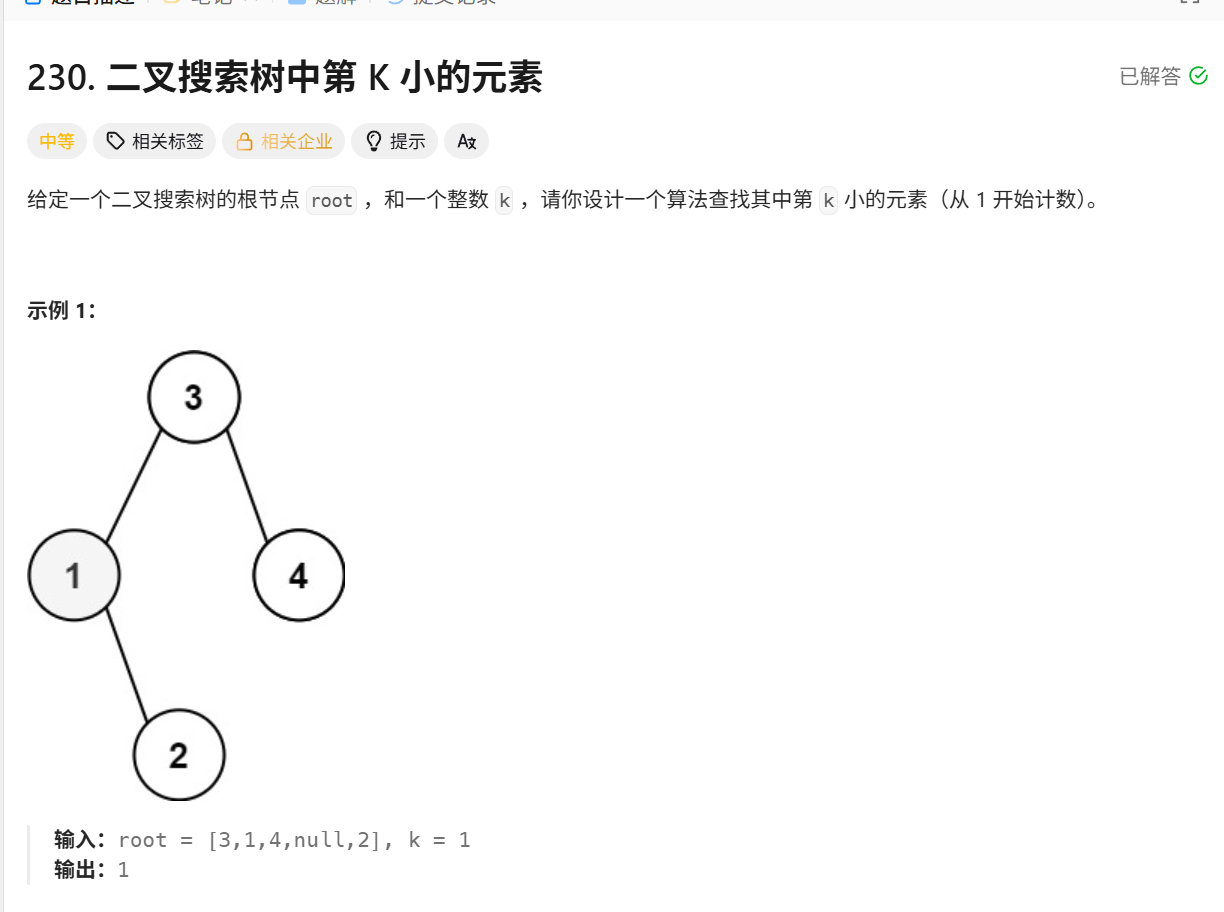
二叉树 二叉搜索树中第 K 小的元素
找最小值,可以将2叉树层级遍历,得到数组后进行排序,直接输出k - 1下标的元素。
1
2
3
4
5
6
7
8
9
10
11
12
13
14
15
16
17
18
19
20
21
22
23
24
public class Solution { public int KthSmallest (TreeNode root, int k ) if (root == null ) return 0 ; List<int > ans = new List<int >(); Queue<TreeNode> queue = new Queue<TreeNode>(); queue.Enqueue(root); while (queue.Count > 0 ){ TreeNode cur = new TreeNode(); cur = queue.Dequeue(); ans.Add(cur.val); if (cur.left !=null ){ queue.Enqueue(cur.left); } if (cur.right !=null ) { queue.Enqueue(cur.right); } } int [] arr = ans.ToArray(); Array.Sort(arr); return arr[k -1 ]; } }
1
2
3
4
5
6
7
8
9
10
11
12
13
14
15
16
17
18
19
20
21
22
23
24
25
26
27
28
29
30
31
32
33
34
35
36
37
38
39
40
41
42
43
44
45
46
47
48
49
50
51
52
53
54
55
56
57
58
59
60
61
62
63
64
65
66
67
68
69
70
71
72
73
public class Solution { public ListNode SwapPairs (ListNode head ) ListNode DummyNode = new ListNode(0 ); DummyNode.next = head; ListNode cur = DummyNode; while (cur.next != null && cur.next.next != null ){ ListNode temp1 = cur.next; ListNode temp2 = cur.next.next.next; cur.next = cur.next.next; cur.next.next = temp1; cur.next.next.next = temp2; cur = cur.next.next; } return DummyNode.next; } public ListNode SwapPairs1 (ListNode head ) if (head == null ) { return head; } int Length = 0 ; ListNode cur = head; while (cur != null ){ cur = cur.next; Length++; } int m = Length / 2 ; ListNode dummy = new ListNode(0 ); dummy.next = head; ListNode prevTail = dummy; cur = head; while (m > 0 ){ ListNode newHead = changeListNode(cur,2 ); prevTail.next = newHead; prevTail = cur; cur = cur.next; m--; } return dummy.next; } public ListNode changeListNode (ListNode head, int k ) if (head == null || k <= 1 ) { return head; } ListNode pre = null ; ListNode current = head; ListNode next = null ; ListNode tailOfReversed = head; while (k > 0 && current != null ) { next = current.next; current.next = pre; pre = current; current = next; k--; } tailOfReversed.next = current; return pre; } }
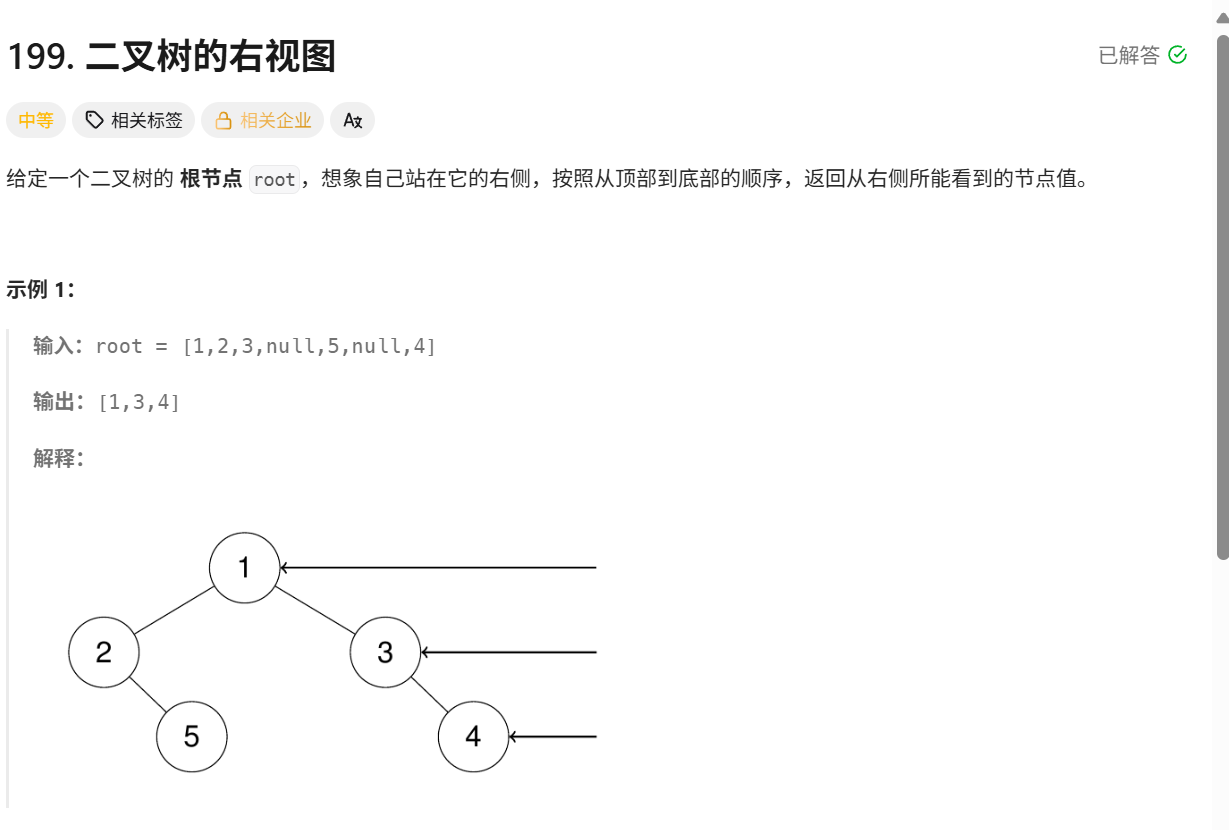
二叉树的右视图
同理,也是使用层级遍历,但是这个层级遍历只存储每层的最后一个元素,即可得到右视图,层级遍历时,记录每层的层数。
1
2
3
4
5
6
7
8
9
10
11
12
13
14
15
16
17
18
19
20
21
22
23
24
25
26
27
28
29
30
31
public class Solution { public IList<int > RightSideView (TreeNode root ) List<int > ans = new List<int >(); if (root == null ) return ans; else { Queue<TreeNode> queue = new Queue<TreeNode>(); queue.Enqueue(root); while (queue.Count > 0 ){ int size = queue.Count; int lastval = 0 ; for (int i = 0 ; i< size;i++){ TreeNode cur = queue.Dequeue(); lastval = cur.val; if (cur.left !=null ){ queue.Enqueue(cur.left); } if (cur.right !=null ) { queue.Enqueue(cur.right); } } ans.Add(lastval); } } return ans; } }
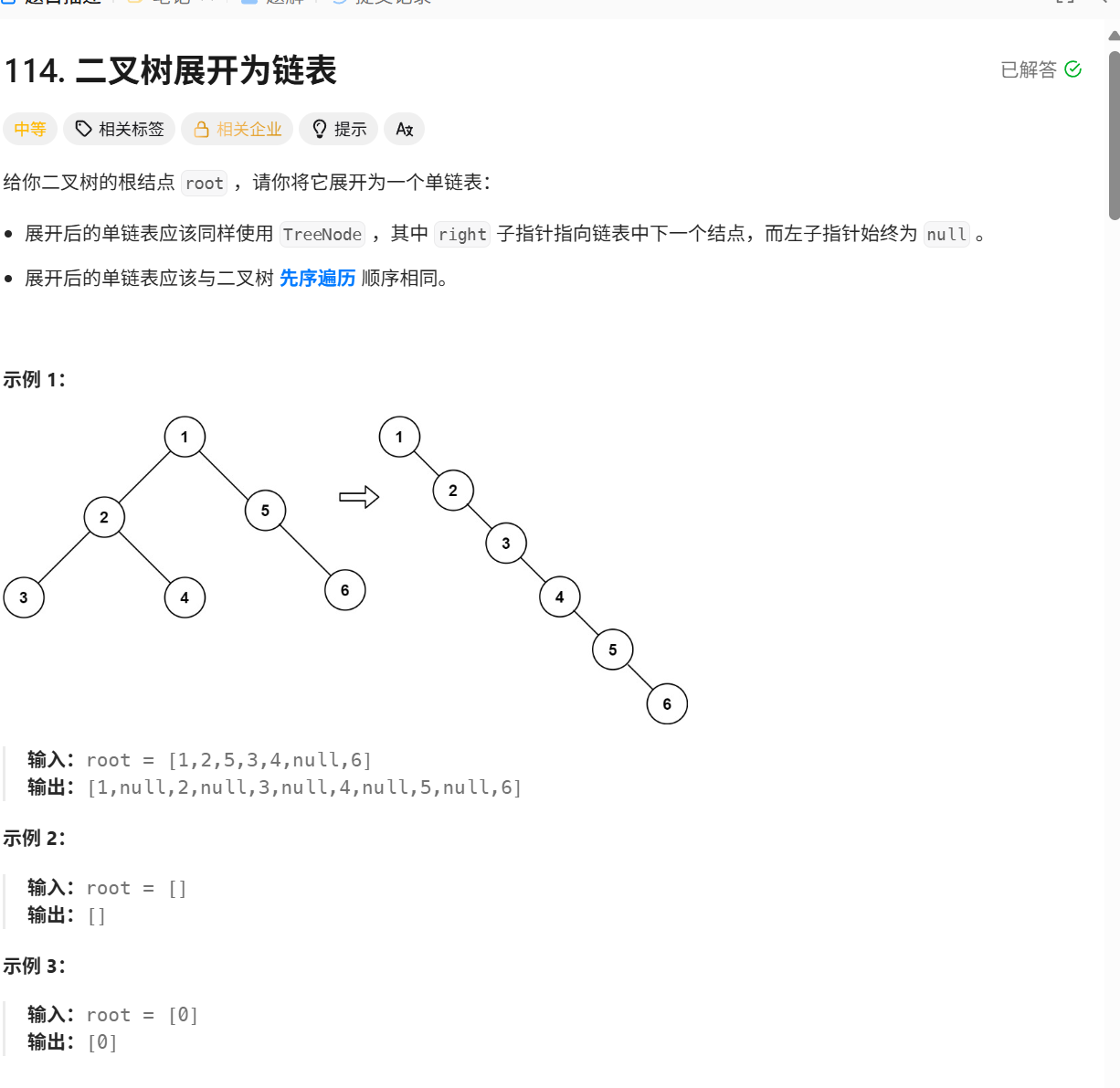
二叉树展开为链表
1.初始化 :•
若根节点为空,直接返回。
创建一个栈,并将根节点压入栈。
维护一个 prev指针,记录前一个节点(初始为 null)。
2.迭代处理 :•
弹出栈顶节点作为当前节点 current。•
若 prev非空:•
将 prev的右指针指向 current(形成链表)。•
将 prev的左指针置空(满足链表要求)。
3.终止条件 :
1
2
3
4
5
6
7
8
9
10
11
12
13
14
15
16
17
18
19
20
21
22
23
24
public class Solution { public void Flatten (TreeNode root ) if (root == null ) return ; Stack<TreeNode> stack = new Stack<TreeNode>(); stack.Push(root); TreeNode prev = null ; while (stack.Count > 0 ) { TreeNode current = stack.Pop(); if (prev != null ) { prev.right = current; prev.left = null ; } if (current.right != null ) stack.Push(current.right); if (current.left != null ) stack.Push(current.left); prev = current; } } }
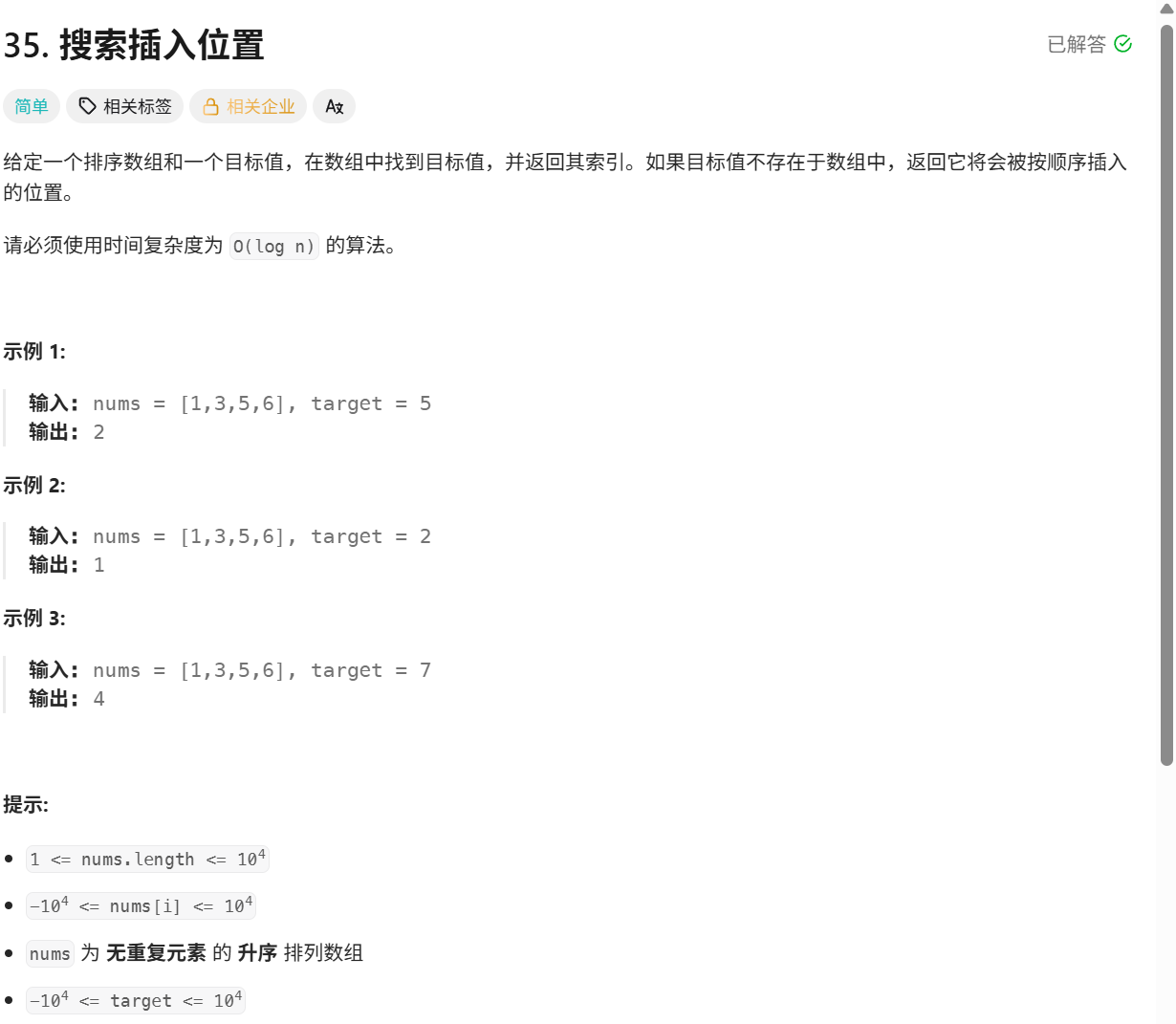
图论 回溯 二分查找 搜索插入位置
使用2分法进行查找,如果没有找到元素,则不存在,并且L的位置则插入的目标位置
1
2
3
4
5
6
7
8
9
10
11
12
13
14
15
16
public class Solution { public int SearchInsert (int [] nums, int target int L = 0 ; int R = nums.Length; while (L <= R){ int mid = (L + (R - L) >> 1 ); if (nums[mid] == target) return mid; else if (nums[mid] < target) L = mid + 1 ; else R = mid - 1 ; } return L; } }
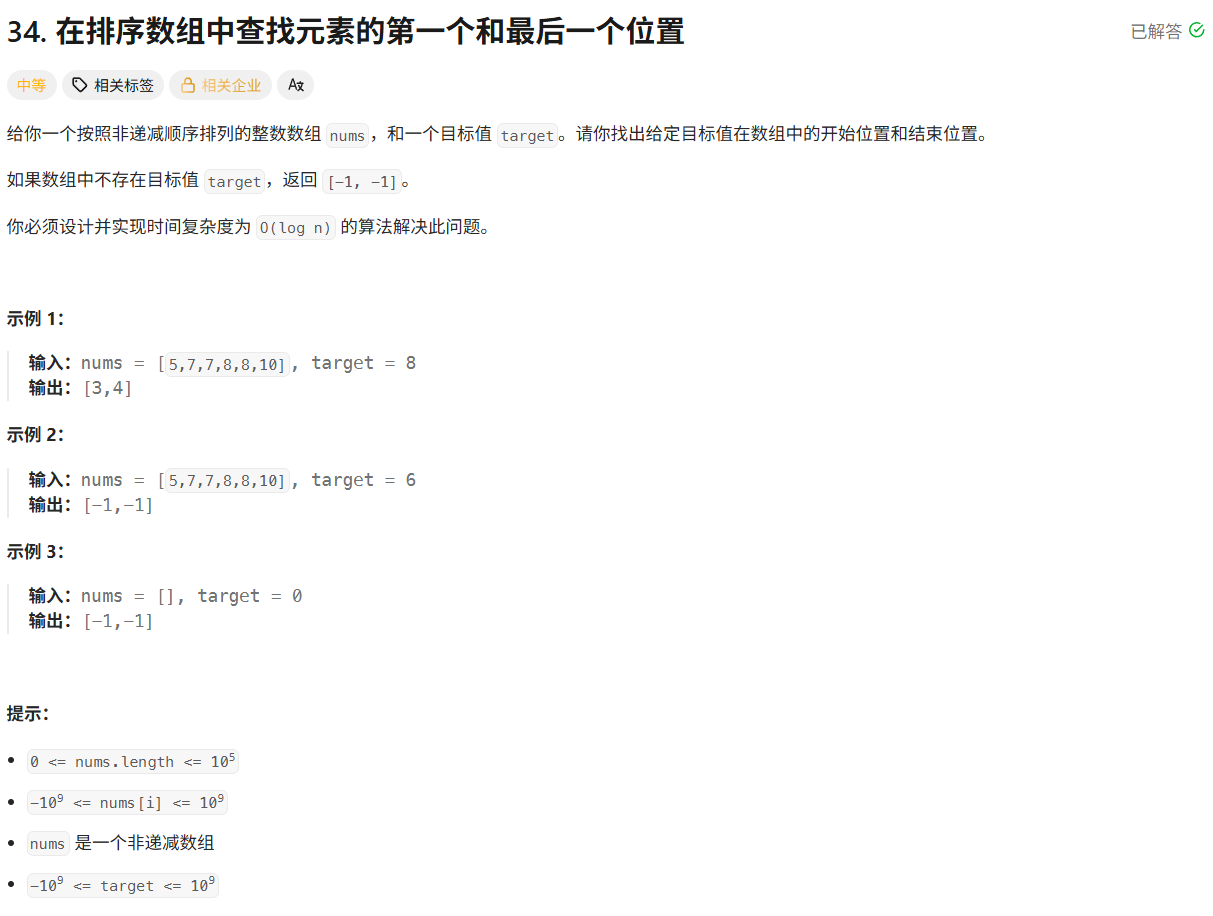
在排序数组中查找元素的第一个和最后一个位置
1
2
3
4
5
6
7
8
9
10
11
12
13
14
15
16
17
18
19
20
21
22
23
24
public class Solution { public int [] SearchRange (int [] nums, int target int L = 0 ; int R = nums.Length -1 ; int start = -1 ; int end = -1 ; while (L <= R){ int mid = (L + (R - L) >> 1 ); if (nums[mid] == target){ start = mid; end = mid; break ; } else if (nums[mid] < target){ L = mid + 1 ; } else R = mid - 1 ; } while (start>0 &&nums[start-1 ]==target)start--; while (end<nums.Length-1 &&nums[end+1 ]==target)end++; return new int []{start,end}; } }
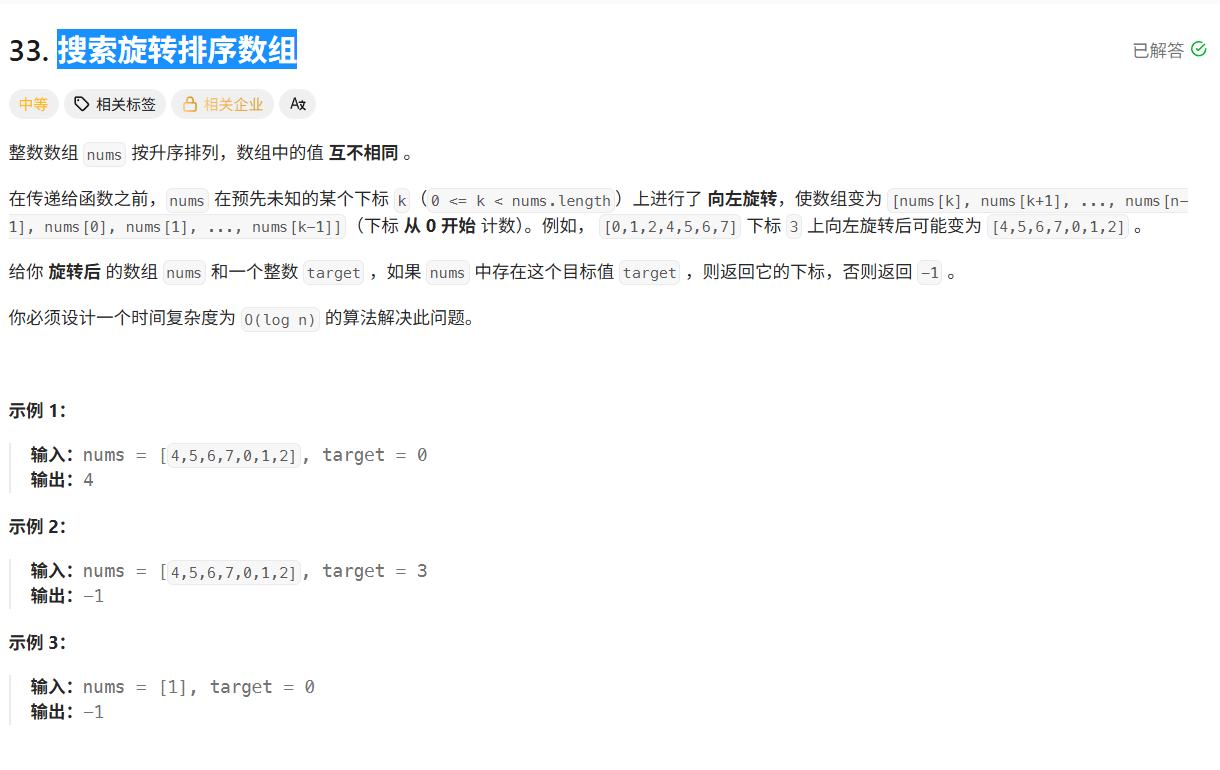
搜索旋转排序数组
旋转后的数组必定mid左边或者右边有序,如果左边有序,判断是否在左边区间,将target与mid索引处进行比较。如果右边有序,则同理。只需要在有序空间进行判断即可。
1
2
3
4
5
6
7
8
9
10
11
12
13
14
15
16
17
18
19
20
21
22
23
24
25
26
27
28
29
30
public class Solution { public int Search (int [] nums, int target int L = 0 ; int R = nums.Length - 1 ; while ( L <= R){ int mid = (L + (R - L) >> 1 ); if (nums[mid] == target){ return mid; } else if (nums[mid] < nums[L]) { if (nums[mid] < target && target <= nums[R]){ L = mid + 1 ; } else { R = mid - 1 ; } } else { if (nums[mid] < target && target >= nums[L]){ R = mid - 1 ; } else { L = mid + 1 ; } } } return -1 ; } }
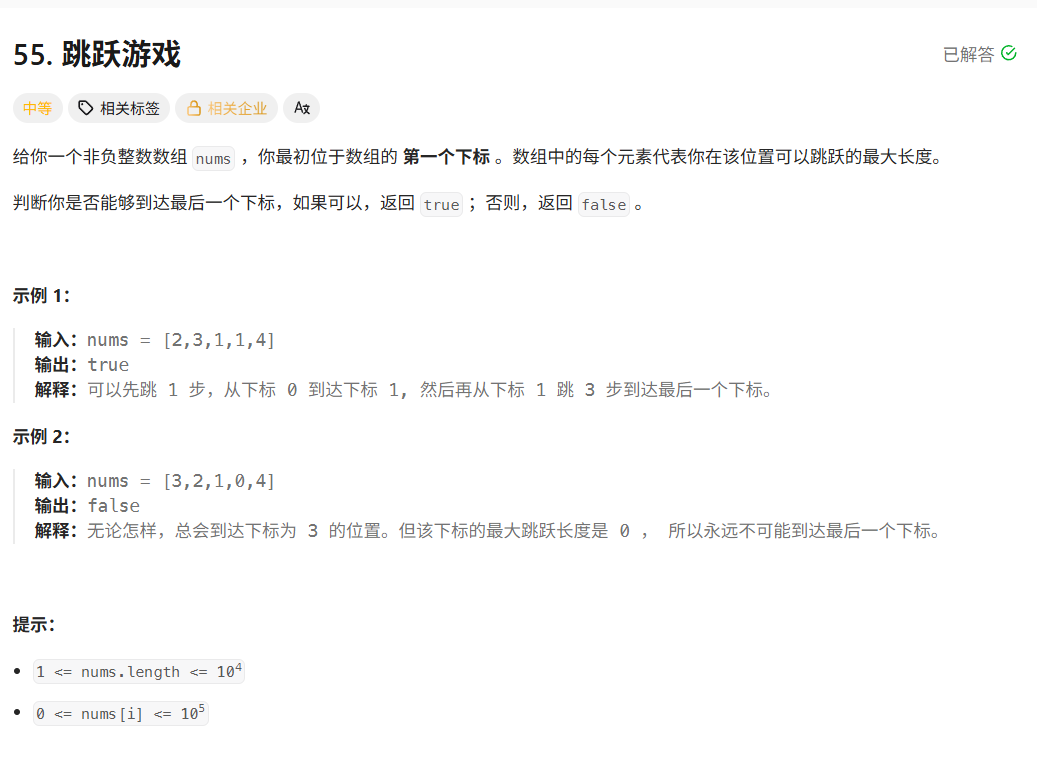
栈 堆 贪心算法 跳跃游戏
.初始化 :Len初始化为 0,表示初始能到达的最远位置(即起点,索引 0)。
2.遍历数组 :
•可行性检查 :在每一步 i,检查当前能到达的最远位置 Len是否小于 i。如果是,说明无法从之前的任何位置跳到 i,直接返回 false。
•更新最远位置 :如果 i可达,则更新 Len为 max(Len, i + nums[i]),即从当前位置 i能跳到的最远位置。
3.成功判断 :如果遍历完整个数组都没有触发 false,说明可以到达终点,返回 true。
1
2
3
4
5
6
7
8
9
10
11
12
13
public static bool jump (int [] nums{ int Len = 0 ; for (int i = 0 ; i < nums.Length; i++) { if (Len < i) { return false ; } Len = Math.Max(Len, i + nums[i]); } return true ; }
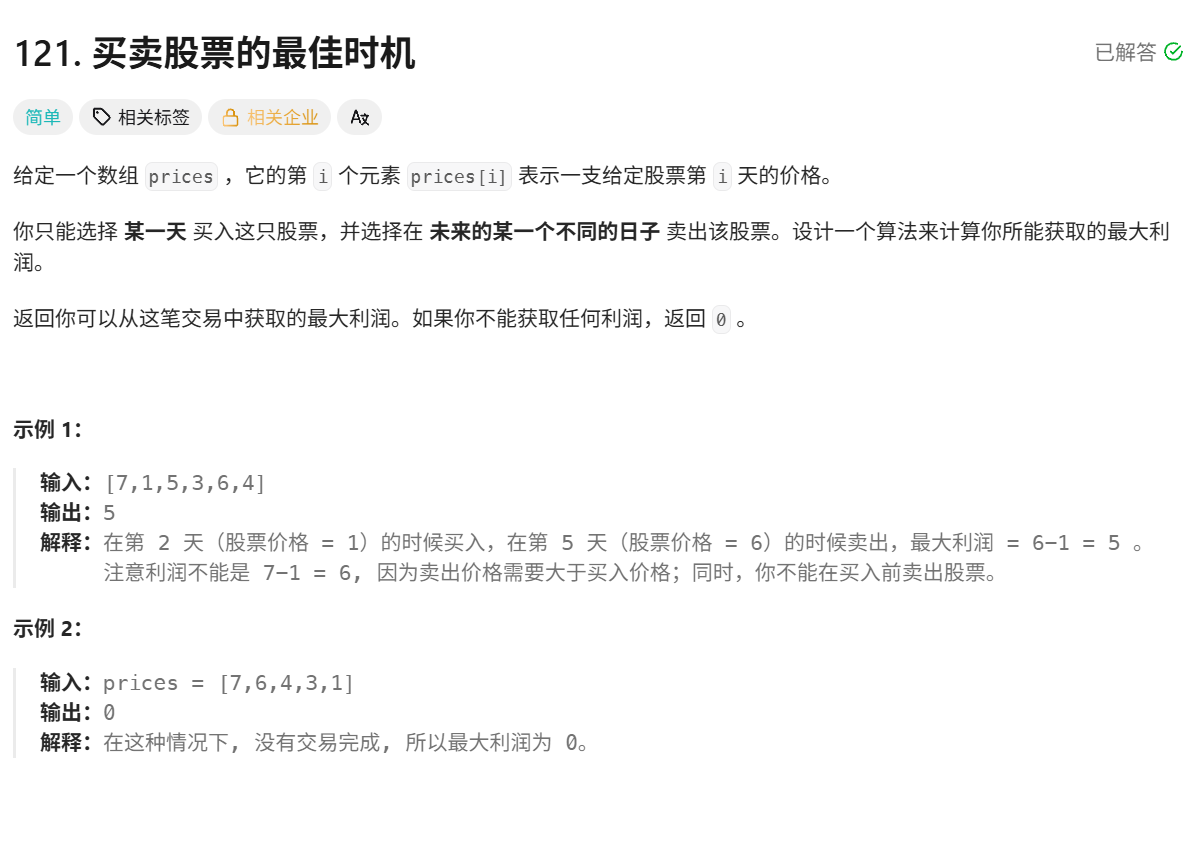
股票股买的最佳时期I
对于该题,只能购买和卖出一次股票,所以需要找到股票的最大值和最小值,并且最大值的下标索引大于最小值。因此设置一个buy变量用于寻找最低的购买价值,profit用于找到每次卖出股票的得到利润,max用于记录最大的利润。
初始化 :将max,profit初始化为0,buy初始化为数组的第一个值prices[0];遍历数组 :
如果当前值大于buy(即购买值),即可卖出得到当前的利润profit(profit = nums[i] - buy),并改变当前max的最大利润
如果当前值小于buy(即购买值),即更新购买价值
.成功找到 :最后得到的max值即为利润最大值
1
2
3
4
5
6
7
8
9
10
11
12
13
14
15
public int MaxProfit (int [] prices int profit = 0 ; int Buy = prices[0 ]; int max = 0 ; for (int i = 1 ;i < prices.Length;i++){ if (prices[i] < Buy){ Buy = prices[i]; } else { profit = prices[i] - Buy; max = Math.Max(max,profit); } } return max; }
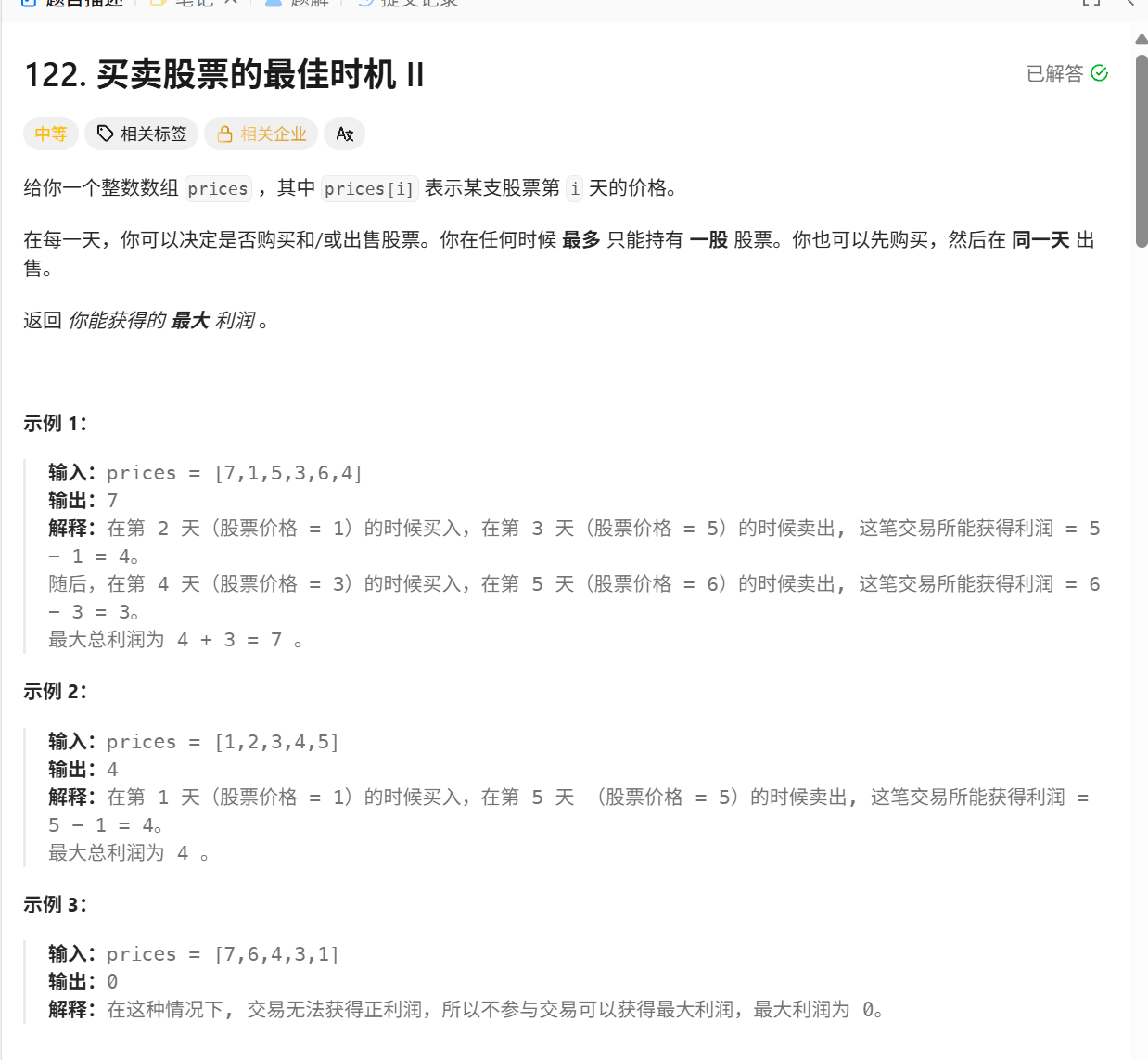
股票购买的最佳时期II
对于该题,可以多次购买和卖出一次股票,因此每当当前的价值大于购买值即卖出,将所有的利润值相加,最后得到最大的价值。
初始化 :将profit初始化为0,buy初始化为数组的第一个值prices[0];遍历数组 :
如果当前值大于buy(即购买值),即可卖出得到当前的利润profit(profit += nums[i] - buy),更新购买价值
如果当前值小于buy(即购买值),即更新购买价值
.成功找到 :最后得到的profit值即为利润最大值
1
2
3
4
5
6
7
8
9
10
11
12
13
14
public class Solution { public int MaxProfit (int [] prices int profit = 0 ; int buy = prices[0 ]; for (int i = 1 ;i < prices.Length;i++){ if (prices[i] > buy){ profit += prices[i] - buy; } buy = prices[i]; } return profit; } }
动态规划
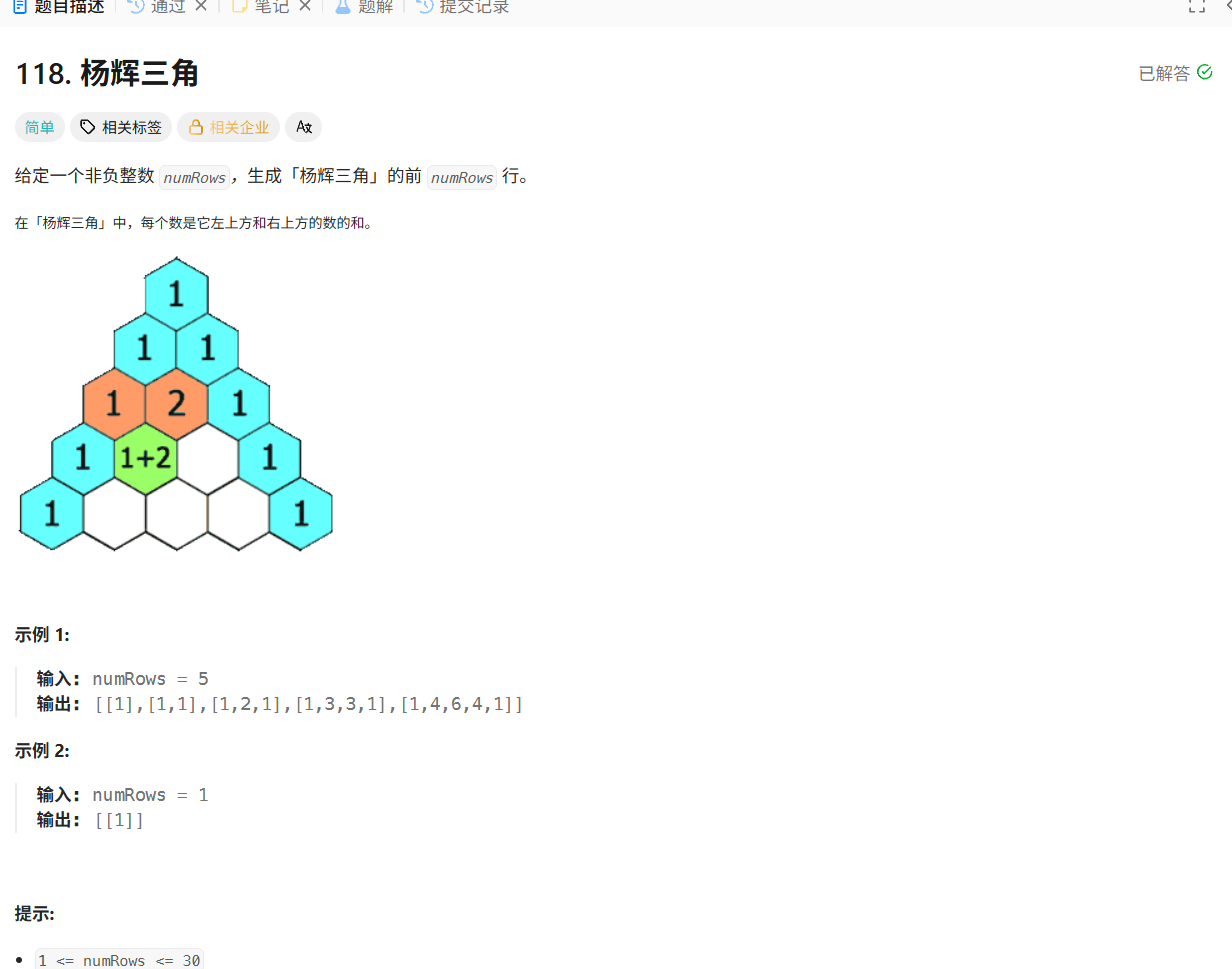
对于此题,采用动态规划求解。
初始化处理 :首先检查输入参数numRows的有效性,如果小于等于0则直接返回空列表基础行处理 :
添加第一行 [1]
如果只需要1行,直接返回
添加第二行 [1, 1]
如果只需要2行,直接返回
动态生成后续行 :从第3行开始循环到目标行数:
获取前一行数据:var prev = ans[i - 2]
创建新行列表,首元素固定为1
计算中间元素:通过循环将前一行的相邻元素相加
末尾元素固定为1
将生成的新行添加到结果列表中
1
2
3
4
5
6
7
8
9
10
11
12
13
14
15
16
17
18
19
20
21
22
23
24
25
public class Solution { public IList<IList<int >> Generate(int numRows) { var ans = new List<IList<int >>(); if (numRows <= 0 ) return ans; ans.Add(new List<int >(){1 }); if (numRows == 1 ) return ans; ans.Add(new List<int >(){1 , 1 }); if (numRows == 2 ) return ans; for (int i = 3 ; i<=numRows;i++){ var prev = ans[i - 2 ]; List<int > res = new List<int >(); res.Add(1 ); for (int j = 1 ; j < i - 1 ;j++){ res.Add(prev[j - 1 ] + prev[j]); } res.Add(1 ); ans.Add(res); } return ans; } }
1
2
3
4
5
6
7
8
public class Solution { public IList<IList<int >> Generate(int numRows) { var ans = new List<IList<int >>(); for (int i = 0 ;i <=numRows;i++){ if (numRows == 0 || ) } } }
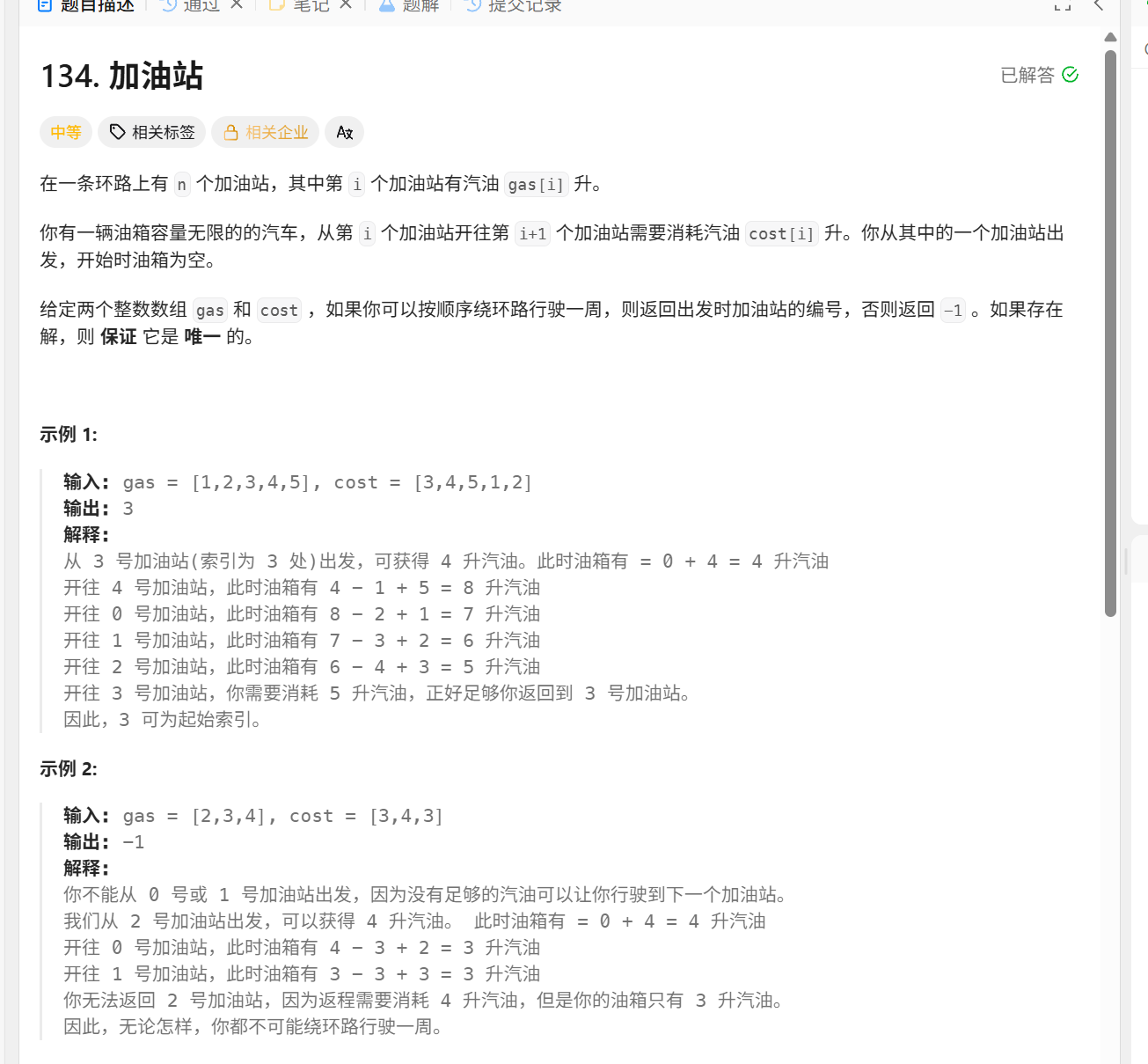
从0号加油站开始遍历,记录当前加油站走到下一个加油站的消耗的油量 costGas,同时使用totalGas记录总的剩余油量,用于是否能够走一圈回到出发的加油站。同时使用一个变量curGas记录当前的剩余油量,如果当前的剩余油量 < 0,证明从当前加油站出发在中间就没有汽油走到下一个加油站了,此时从下一个加油站开始遍历。循环往复,如果没有一个加油站满足,直接返回-1;
1
2
3
4
5
6
7
8
9
10
11
12
13
14
15
16
17
18
19
public class Solution { public int CanCompleteCircuit (int [] gas, int [] cost if (gas.Length == 0 ) return -1 ; int index = 0 ; int totalGas = 0 ; int curGas = 0 ; for (int i = 0 ; i < gas.Length;i++){ int costGas = gas[i] - cost[i]; totalGas += costGas; curGas += costGas; if (curGas < 0 ){ index = i + 1 ; curGas = 0 ; } } return totalGas >= 0 ? index : -1 ; } }
多维动态规划 技巧 两数相加
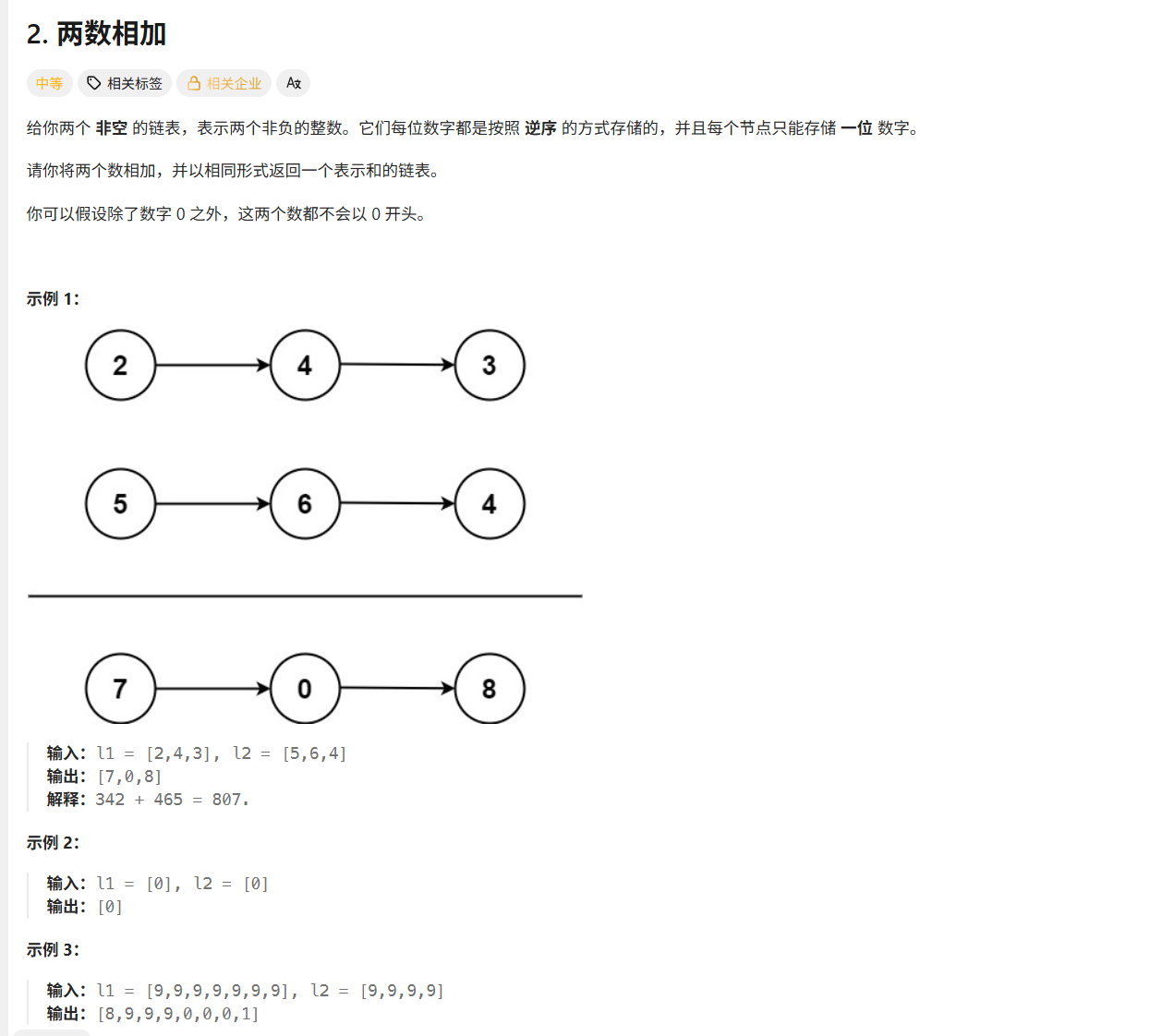
对齐处理 :
短链表末尾补零,使其与长链表长度一致。
示例 :1→2→3+ 4→5视为 1→2→3+ 4→5→0。
逐位相加 :
同步遍历两链表,对应位相加并计算进位。
当前位结果 = (节点1值 + 节点2值 + 进位) % 10。
新进位 = (节点1值 + 节点2值 + 进位) / 10。
处理最终进位 :
1 2 3 4 5 6 7 8 9 10 11 12 13 14 15 16 17 18 19 20 21 22 23 24 25 26 27 28 29 30 31 32 33 34 35 36 37 38 39 40 41 42 public class Solution { public ListNode AddTwoNumbers (ListNode l1, ListNode l2 ) int carry = 0 ; ListNode newNode = new ListNode(0 ); ListNode current = newNode; while (l1!=null || l2!=null ||carry!=0 ){ int x = (l1 != null ) ? l1.val : 0 ; int y = (l2 != null ) ? l2.val : 0 ; int num = x + y + carry; carry = num /10 ; current.next = new ListNode(num % 10 ); current = current.next; if (l1 != null ) l1 = l1.next; if (l2 != null ) l2 = l2.next; } return newNode.next; } }
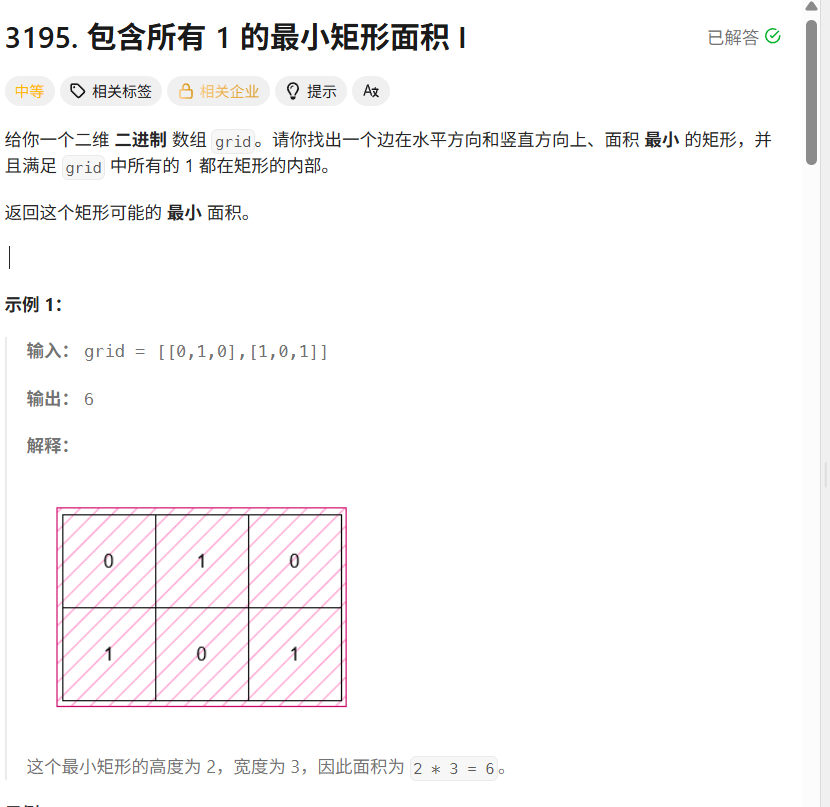
遍历二维网格中的每个元素,记录所有值为 1 的元素所在位置的最小行索引(minX)、最大行索引(maxX)、最小列索引(minY)和最大列索引(maxY),这些索引分别构成了包含所有 1 的最小矩形的上下左右边界,最后通过公式(maxX - minX + 1)×(maxY - minY + 1)计算该矩形的面积,即为所求的最小面积。
1
2
3
4
5
6
7
8
9
10
11
12
13
14
15
16
17
18
19
20
public class Solution { public int MinimumArea (int [][] grid int minX = grid.Length - 1 ; int maxX = 0 ; int minY = grid[0 ].Length - 1 ; int maxY = 0 ; for (int i = 0 ;i < grid.Length;i++){ for (int j = 0 ;j < grid[0 ].Length;j++){ if (grid[i][j] == 1 ){ minX = Math.Min(minX,i); maxX = Math.Max(maxX,i); minY = Math.Min(minY,j); maxY = Math.Max(maxY,j); } } } return (maxX - minX + 1 )*(maxY - minY + 1 ); } }