
并查集
并查集
并查集(Union-Find)是一种用于管理不相交集合(Disjoint Sets)的数据结构,主要支持以下两种高效操作:
Find(查找):查询某个元素所属的集合(通常返回该集合的代表元素)。Union(合并):将两个集合合并为一个集合。
此外,并查集通常还支持:
- 初始化(
MakeSet):为每个元素单独创建一个集合。 - 判断两个元素是否属于同一集合(
isSameSet)。
核心概念
- 集合的代表(Root / Parent):
- 每个集合有一个代表元素(通常称为根节点或父节点)。
- 所有属于该集合的元素的
Find操作最终都会指向这个代表元素。
- 路径压缩(Path Compression):
- 在
Find操作时,将查询路径上的所有节点直接指向根节点,以优化后续查询效率。
- 在
- 按秩合并(Union by Rank / Size):
- 在
Union操作时,将较小的集合合并到较大的集合中,以保持树的平衡,提高效率。
- 在
| 操作 | 普通实现 | 路径压缩 + 按秩合并 |
|---|---|---|
Find |
O(n) | O(α(n)) (接近常数) |
Union |
O(n) | O(α(n)) (接近常数) |
isSameSet |
O(n) | O(α(n)) (接近常数) |
1 | public class Node<T> |
数组优化并查集
1 | public class UnionSet{ |
岛屿数量
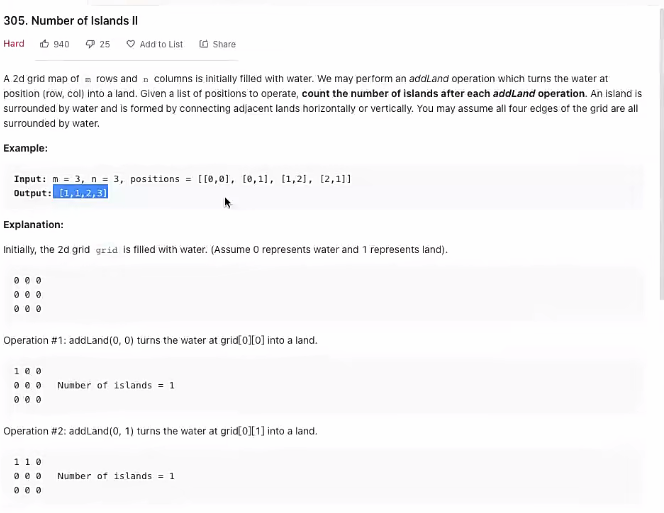
题目描述:给定一个 m x n 的网格,初始时所有单元格都是水域。操作 positions 中的每个元素 positions[i] = [ri, ci] 表示在网格的 (ri, ci) 处添加一块陆地。返回一个列表,其中第 i 个元素是第 i 次操作后岛屿的数量。
算法思路:使用并查集(Union-Find)来动态维护岛屿数量。每次添加一块新陆地时,先将其视为一个独立的岛屿,然后检查其上下左右四个方向,如果相邻单元格是陆地,则进行合并(Union)操作。并查集需要支持路径压缩和按秩合并(使用大小作为秩)以提高效率。
具体步骤:
1.初始化并查集,大小为 m * n,初始时所有单元格的父节点为自己,但大小(size)为0(表示水域)。
遍历每个操作位置 (r, c):
a. 计算索引 index = r * n + c(注意列数 n)。
b. 如果该位置已经是陆地(size[index] > 0),则直接返回当前岛屿数量(避免重复添加)。
c. 否则,将该位置初始化为陆地:父节点为自己,大小设为1,岛屿数(sets)加1。
d. 检查上下左右四个方向:
如果相邻位置存在且是陆地,则与当前位置进行合并。
合并时,找到两个位置的根节点,如果根节点不同,则根据大小合并(小树合并到大树),同时岛屿数减1。
每次操作后,记录当前岛屿数量到结果列表。
1 | using System.Collections.Generic; |
本博客所有文章除特别声明外,均采用 CC BY-NC-SA 4.0 许可协议。转载请注明来源 岁迹!
相关推荐

2026-06-27
异或相关面试题
异或:2进制相同为0,不同为1。同时满足交换律和结合律 0 ^ N = N N ^ N = 0 同或:2进制相同为1,不同为0 题一:如何不用额外遍历交换两个数默认情况是使用临时变量来存储一个数,最后交换。在此处我们使用异或运算,依靠异或的下列特点来进行交换。 123456789//默认情况int tmp = a;a = b;b = tmp;//依靠异或,但是条件是,A,B指向的是不同的内存区域a = a ^ b;b = a ^ b;a = a ^ b; 0 ^ N = N N ^ N = 0 题二:一个数组中有一种数出现了奇数次,其他数都出现了偶数次,怎么找到并且打印这种数(LeetCode136)默认情况是使用字典进行存储,将每种数作为键进行存储,值则为出现的次数,最后循环找到奇数次的那种数. 创建一个变量赋值为 0,使用该变量异或遍历每一个数组的值,即可。 1234567891011static void Main(string[] args){ int[] arrs = { 1, 1,2, 2, ...
2026-06-27
一些基础的数据结构
动态数组 装箱:装箱是指将值类型转换为引用类型的过程。值类型(如 int、char、struct 等)通常存储在栈上,而引用类型存储在堆上。当进行装箱操作时,会在堆上为值类型创建一个对象实例,并将值类型的值复制到该对象中,最后返回这个对象的引用。 拆箱:拆箱则是将引用类型转换为值类型的过程。它需要先检查引用类型是否为某个特定值类型的装箱实例,然后将堆上对象中存储的值复制到栈上的新值类型变量中。 装箱开销:装箱操作会在堆上分配内存,并且需要复制值类型的值,这会带来一定的性能开销,尤其是在频繁进行装箱操作时,会导致内存分配和垃圾回收的压力增加。 拆箱开销:拆箱操作需要进行类型检查,确保引用类型确实是某个值类型的装箱实例,这也会带来一定的性能开销。 动态数组指的是是大小能在程序运行期间动态调整的数组,可根据实际需求增添或删减元素。与固定大小的数组不同,动态数组能够灵活应对元素数量的变化,从而更高效地管理内存。以下通过自定义的类实现动态数组,使用泛型类,来进行动态数组的实现,这样可以根据数组的类型,实现相应的功能,同时实现IEnumerable接口,可以被foreach循环遍历...
2026-06-27
KMP和Manacher算法
Manacher算法 预处理:统一奇偶长度 回文串有奇数长度(如”aba”)和偶数长度(如”abba”)之分,这会给统一处理带来麻烦。 Manacher算法通过在原始字符串的每个字符之间以及首尾插入一个原字符串中不存在的特殊字符(通常用#)来进行预处理。例如,"abba"会被处理成 "#a#b#b#a#"。 这样做的好处是:无论原字符串如何,新字符串的长度总是奇数,所有回文子串都变成了奇数长度,从而可以统一以每个字符为中心进行扩展检查。 利用回文对称性 算法维护一个回文半径数组 P(也称为辅助数组),P[i]表示以新字符串中第 i个字符为中心的最长回文子串的半径(包含中心字符本身)。例如,对于字符串 "#a#b#a#",以中间的 b(位于索引4)为中心,其回文半径是4。 关键在于,算法在从左至右遍历字符串时,会动态维护一个当前已知的最右回文边界 R 以及达到该边界的中心位置 C。 当遍历到位置 i时,如果 i在当前最右边界 R之内,则可以找到 i关于中心 C的对称点 j。根据回文的对称性,可以利用 P[j]的值来快速...
2026-06-27
动态规划
暴力递归暴力递归的关键要素一个典型的暴力递归算法包含三个要素: 1.递归终止条件: 定义问题最简单的情况,并直接返回结果。这是递归的出口,没有它会导致无限递归。 2.问题分解: 在每一步,将当前问题分解成一个或多个规模更小的同类型子问题。 3.决策与尝试: 对于当前步骤,做出一个选择(或尝试所有可能的选择),然后基于这个选择递归地解决子问题,并将子问题的结果组合起来形成当前问题的解。 Hanoi塔问题设a,b,c是3个塔座。要求由a移动到b。移动圆盘时遵守以下移动规则规则1:每次只能移动1个圆盘;规则2:任何时刻都不允许较大的圆盘压在较小的圆盘之上:规则3:在满足移动规则1和2的前提下,可将圆盘移至a,b,c中任一塔座上, 123456789101112131415public class Solution { public void Hanota(IList<int> A, IList<int> B, IList<int> C) { Hanoi(A.Count,A,B,C); } ...
2026-06-27
链表面试题
判断链表是否为回文1.使用容器栈来进行,将所有的数据压入栈,在一个一个出栈与链表进行比较,只要不相同就直接return false 123456789101112131415161718public bool isTenet(Node head){ Stack<int> Contains = new Stack<int>(); Node cur = head; while (cur != null) { Contains.Push(cur.e); cur = cur.next; } cur = head; while (cur != null) { if (Contains.Pop() != cur.e) return false; cur = cur.next; } return true;} 2.翻转后端链表,使用快慢指针找到中间节点,找到后翻转后半部分的...
2026-06-27
LeetCode-Hot100
哈希表两数之和 解答一:使用暴力算法 12345678910111213public int[] TwoSum(int[] nums, int target) { int[] arrs = new int[2]; for(int i = 0; i < nums.Length; i++) { for(int j = i + 1; j < nums.Length; j++) { if(nums[i] + nums[j] == target) { arrs[0] = i; arrs[1] = j; return arrs; // 找到后立即返回,提升效率 } } } return arrs;} 解答二:使用字典 12345678910111213141516public class Solution
...